

Key Points
- There are 8 main causes of humidity on walls: from harmless condensation to hidden leaks in embedded pipes that Telefuga detects with infrared thermography
- The color, location, and consistency of the stain are the 3 key indicators to distinguish whether the humidity comes from a real water leak
- With 38,000 leaks resolved and a rating of 4.8/5 on Google (319 reviews), Telefuga locates embedded leaks without breaking walls thanks to the geophone and tracer gas
- Leaks in embedded pipes, broken downspouts, and heating circuits are the 3 causes that always require professional detection
- An incorrect diagnosis can cost you thousands of euros in unnecessary renovations: first locate, then repair
Data updated in September 2026 — Information verified with internal data from Telefuga and real reviews from Google Maps.
Why does humidity appear on the walls of your house?
Humidity on walls is one of the most common problems in Spanish homes, and also one of the worst diagnosed. Approximately 40% of the humidity that our technicians at Telefuga inspect turns out to be hidden water leaks, not simple condensation or capillarity problems as homeowners initially suspect. After 16 years of experience and 38,000 leaks resolved in Murcia, Alicante, Valencia, Albacete, and Almería, we have learned that the difference between an accurate diagnosis and an erroneous one can mean thousands of euros in repairs.
This article will guide you through the 8 main causes of humidity on walls, teach you to distinguish them by their visual symptoms, and above all, explain when you need to call a professional for water leak detection before spending a single euro on renovations.
The 8 causes of humidity on walls: complete guide
1. Condensation: the most common and least dangerous cause
Condensation occurs when the water vapor present in the air comes into contact with a cold surface —typically a poorly insulated exterior wall— and transforms into liquid water droplets. It is the same phenomenon that occurs when you take a cold water bottle out of the refrigerator in summer.
How to identify it:
- Stain color: Black or gray mold, especially in upper corners
- Location: Corners of rooms, behind furniture pressed against exterior walls, window frames
- Consistency: Appears and disappears depending on the time of year (worse in winter)
- Smell: Characteristic musty smell, especially when closing the room
Solution: Improve ventilation (open windows for 10-15 minutes a day), install extractors in bathrooms and kitchens, consider interior thermal insulation (backing with rock wool or extruded polystyrene). In humid climates like the coast of Alicante or Valencia, a dehumidifier may be necessary from November to March.
Telefuga Fact: In our experience, approximately 25% of the calls we receive for "humidity" turn out to be pure condensation. However, we have seen cases where condensation masked a real leak underneath: the additional humidity from the leak raised the relative humidity of the room, causing secondary condensation on the walls.
2. Capillarity: humidity that rises from the ground
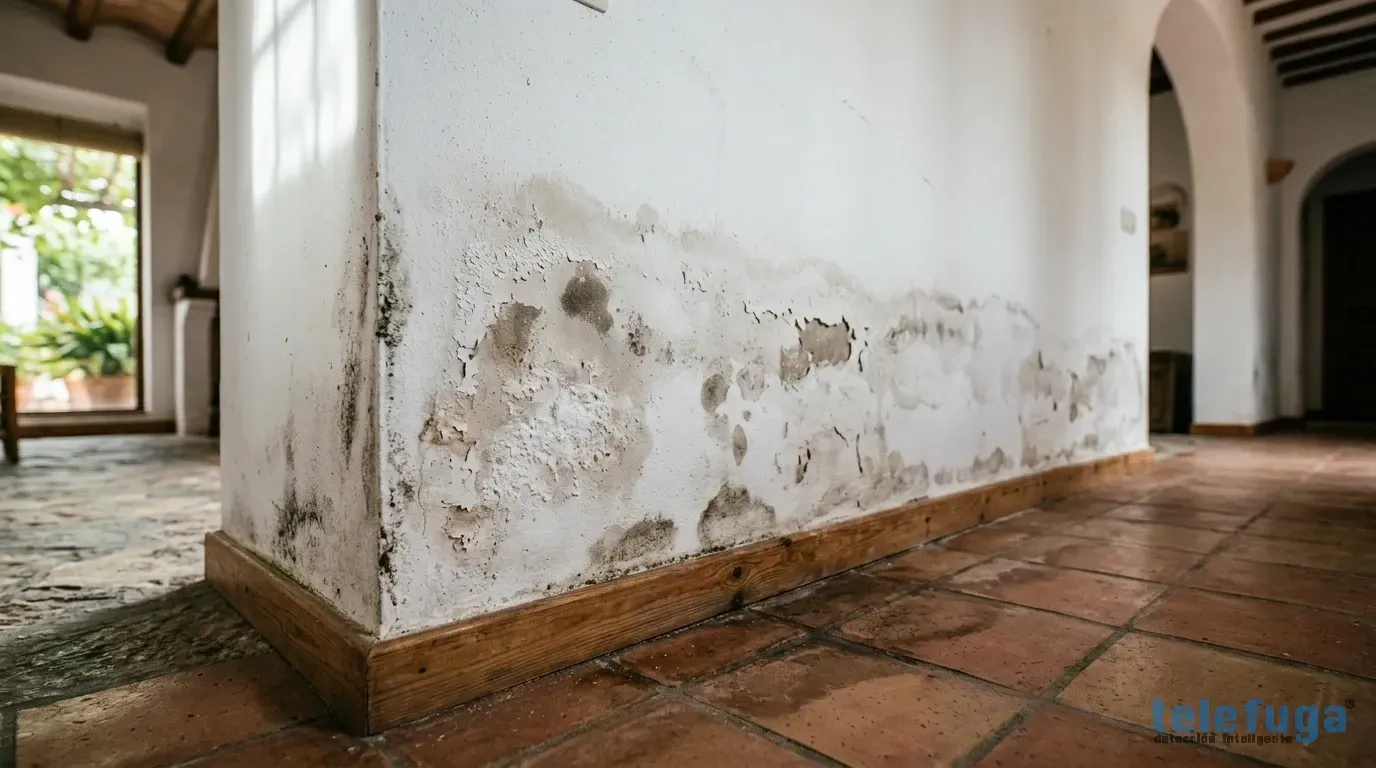
Capillary humidity is a physical phenomenon by which water from the subsoil rises through the pores of construction materials (brick, mortar, stone) as if it were a sponge. It can reach heights of up to 1.5 meters in severe cases.
How to identify it:
- Stain color: Irregular horizontal line with white efflorescence (crystallized mineral salts)
- Location: Always at the bottom of the wall, from the ground upwards, never on upper floors
- Consistency: Permanent, worsens during rainy seasons or when the groundwater level rises
- Smell: Musty smell, with peeling paint and plaster
Solution: Injection of water-repellent resins at the base of the wall, creation of a ventilated air chamber, exterior perimeter drainage. Superficial solutions (anti-humidity paint, waterproof coatings) only temporarily mask the problem.
Capillarity is especially common in homes built before 1980 in areas like the Huerta de Murcia or the Vega Baja del Segura (Alicante), where the groundwater level is high and many constructions lack a waterproofing membrane in the foundation.
3. Facade filtration: water enters from outside
Facade filtrations occur when rainwater penetrates through cracks, fissures, deteriorated joints, or porous coatings of the exterior wall. It is especially frequent in facades facing east or southeast, which receive the direct impact of the easterly wind laden with rain.
How to identify it:
- Stain color: Irregular dark stains, often shaped like a "tear" or vertical streak
- Location: Walls facing outside, around windows, at junctions of facade with balconies
- Consistency: Appears after heavy rains, partially dries between episodes
- Smell: No strong smell, but can generate mold if it recurs
Solution: Repair cracks with elastic mortar, seal expansion joints, apply breathable water-repellent on the facade, check drip edges and ledges. In communities of owners, facade repair is a community responsibility according to Article 10 of the Horizontal Property Law.
4. Leak in embedded pipe: the invisible enemy
This is the cause that worries the most and the one that is hardest to diagnose without professional equipment. Cold and hot water pipes that run embedded within walls can develop leaks due to corrosion, material fatigue, defective joints, or structural movements.
How to identify it:
- Stain color: Circular or oval stain that grows progressively, of uniform color (no white salts like capillarity)
- Location: At any point on the wall, but frequently near bathrooms, kitchens, or areas where pipes run
- Consistency: Permanent and progressive, does not depend on rain or the time of year
- Smell: May have a stagnant musty smell; if the leak is in hot water, the wall may feel warm to the touch
Solution: Detection with geophone to locate the exact point of the leak without the need to break the entire wall. Once located, punctual repair of the affected section or, if the installation is old, external visible recanalization or through a false ceiling.
Real case Telefuga: In 2024, a client from Murcia had been struggling with "condensation humidity" on the wall of their bathroom for 8 months. They had applied anti-humidity paint twice and even installed an industrial dehumidifier. When our technician conducted an inspection with infrared thermography, the thermal image clearly revealed a hot spot on the wall: a leak of just 2 mm in the embedded hot water pipe located 40 cm from the ground. The repair cost 280€. The previous "solutions" had cost over 1,200€ without resolving anything.
5. Filtration from roof or terrace: water comes down from above
Waterproofing problems in flat roofs, terraces, and rooftops are one of the most frequent causes of humidity in the upper floors of buildings. The waterproofing membrane has a lifespan of 15-25 years, and its deterioration allows water to enter with each rain.
How to identify it:
- Stain color: Yellowish or brown stains on the ceiling that extend towards the walls
- Location: Ceiling and upper part of the walls of the top floor, or below terraces
- Consistency: Directly related to rainfall, may take hours or days to manifest
- Smell: Musty smell, possible appearance of active leaks during heavy rains
Solution: Waterproofing the roof with EPDM, PVC, or sprayed polyurethane membrane. Review and seal drains, expansion joints, and junctions with perimeter walls. In communities, this expense corresponds to the community.
6. Broken or cracked downspout: constant dripping inside the wall
Downspouts for wastewater and rainwater run vertically through the interior of buildings, usually embedded or in shafts. When they crack —due to age, structural movements, or clogs that generate pressure— they cause humidity that can affect several floors simultaneously.
How to identify it:
- Stain color: Dark stains with possible yellowish or greenish tone (wastewater)
- Location: Vertical band on the wall, affecting several floors in the same line
- Consistency: Intermittent, coincides with the use of toilets on upper floors
- Smell: Unpleasant smell characteristic of sewage, especially if it is a residual downspout
Solution: Inspection with CCTV camera to locate the exact crack. Punctual repair with stainless steel sleeve or downspout repair without works through interior lining with epoxy resin, avoiding the demolition of the wall.
7. Leak from the neighbor: humidity that is not yours
One of the most frustrating situations: the humidity on your wall comes from a leak in the adjacent home or the upper floor. Water travels by gravity and capillarity through slabs and party walls, sometimes manifesting meters away from the original leak.
How to identify it:
- Stain color: Variable, depends on the type of water and path
- Location: Ceilings, party walls, areas near the neighbor's bathrooms or kitchens
- Consistency: Permanent, does not depend on rain
- Smell: May have a smell depending on the type of water (sanitary, heating)
Solution: First, professional detection to confirm the origin. Telefuga issues a forensic report that documents the origin of the leak, essential for claiming from the neighbor or the community insurance. According to Article 1902 of the Civil Code, the party responsible for the damage is obliged to repair it.
8. Leak in heating circuit: hot water under the floor
Systems of underfloor heating or radiator circuits transport pressurized hot water through pipes that run under the floor or embedded in walls. A leak in these circuits is especially dangerous because hot water (40-60°C) accelerates corrosion and causes structural damage faster than cold water.
How to identify it:
- Stain color: Diffuse stain at the base of the wall or on the floor
- Location: Floors, baseboards, base of walls, usually in areas where the circuit runs
- Consistency: Appears when heating is turned on, disappears or reduces when turned off
- Smell: No smell, but the floor may be abnormally warm at a specific point
Solution: Detection with infrared thermography (the most effective technique for this type of leak) and punctual repair of the section. We explain it in detail in our article on leaks in heating and radiators.
Diagnostic table: identify your humidity in 3 steps
Use this table to guide your diagnosis before calling a professional. Observe the stain, check the conditions, and cross-reference the data:
| Symptom | Probable cause | Is it a leak? | Solution |
|---|---|---|---|
| Black mold in upper corners | Condensation | No | Ventilation + insulation |
| White salts at the base of the wall | Capillarity | No | Injection of resins + drainage |
| Stains after heavy rains, exterior wall | Facade filtration | No | Sealing of cracks + water-repellent |
| Circular stain that grows, does not depend on rain | Leak in embedded pipe | Yes | Professional detection |
| Yellow stain on ceiling, top floor | Filtration from roof | No (filtration) | Waterproofing roof |
| Dark vertical band with bad smell | Broken downspout | Yes | CCTV + lining |
| Humidity on ceiling/party wall, without rain | Leak from neighbor | Yes | Forensic report + claim |
| Warm floor + humidity in baseboard, only with heating | Heating leak | Yes | Infrared thermography |
When does humidity indicate a real leak? The 5 warning signs
Not all humidity on walls is a water leak, but there are unmistakable signs that should alert you immediately:
1. The stain does not depend on rain or the season. If the humidity remains constant or grows regardless of the weather, there is a continuous water source: a leaking pipe.
2. The water meter spins with all faucets closed. This is the simplest and most definitive test. Close all faucets, appliances that use water (washing machine, dishwasher), and toilets. If the meter wheel keeps spinning, you have a leak.
3. The water bill has risen without explanation. An increase of 20-30% or more compared to the same period last year, without a change in your consumption habits, is suspicious.
4. The stain appears far from exterior walls. If the humidity is on an interior wall that does not face the outside or is not on the ground floor, capillarity, facade filtration, and condensation can be practically ruled out.
5. The wall is warm to the touch at the damp point. This indicates a high probability of a leak in the hot water pipe or in the heating circuit.
Infrared thermography: how Telefuga sees invisible humidity
Infrared thermography is the technology that has revolutionized the diagnosis of humidity on walls. It works by capturing the infrared radiation emitted by objects, transforming it into a thermal image where each color represents a different temperature.
Why is it so effective for detecting leaks? Because water alters the surface temperature of the wall. A damp area appears in the thermal image with a different temperature than the surrounding dry area, revealing:
- The real extent of the humidity, which is always greater than what is visible to the naked eye
- The point of origin of the leak, which appears as the coldest (cold water) or hottest (hot water) core
- The path of the water through the interior of the wall, from the leak to the visible stain
- If there are multiple leaks simultaneously, something impossible to detect visually
At Telefuga, we use high-resolution thermal cameras (<0.05°C thermal sensitivity) that allow us to detect minimal temperature differences. In many cases, thermography reveals leaks that have been active for months and that the owner confused with condensation.
Advantages of thermography over traditional methods
| Aspect | Traditional method (breaking) | Infrared thermography |
|---|---|---|
| Damage to the home | High (demolition of walls) | Zero (non-invasive) |
| Diagnosis time | Days or weeks | 30-90 minutes |
| Accuracy | Depends on luck | Exact location (±10 cm) |
| Total cost | 500-3,000€ (includes repair of damages) | 150-400€ (detection only) |
| Documentation | No objective documentation | Thermal images + report |
Geophone: exact location without breaking walls
When thermography identifies the general area of the leak, the electronic geophone allows for fine-tuning the location to the exact point. This instrument amplifies the sound of water escaping from the pipe —a characteristic hissing or dripping— and transmits it to the technician through high-sensitivity headphones.
The geophone is especially useful for:
- Leaks in pipes embedded in walls more than 15 cm thick
- Leaks under slabs or ceramic flooring
- Cold water pipes where thermography has less contrast
- Confirming whether the leak is in your home or in the neighbor's
At Telefuga, 98% of our detections manage to locate the leak without the need to break more than 30x30 cm of wall, compared to the traditional method that may require demolishing linear meters of wall.
Real case: persistent humidity in bathroom that turned out to be an embedded leak
This case perfectly illustrates why professional diagnosis is essential when humidity persists:
Situation: Owner of a home in Alicante city, built in 2001. Detected a humidity stain on the bathroom wall, just below the sink. For 8 months, they tried various solutions on their own:
- Month 1-2: Applied anti-humidity paint (35€). The stain reappeared in 3 weeks.
- Month 3: Called a painter who scraped the wall and applied professional anti-mold treatment (180€). Stain returned in 5 weeks.
- Month 4-5: A builder told them it was condensation and installed a bathroom extractor (250€). No improvement.
- Month 6: Bought an industrial dehumidifier (320€). The stain continued to grow.
- Month 7-8: The stain spread to the adjoining bedroom. Persistent smell. The baseboard began to peel off.
Telefuga intervention:
- Inspection with infrared thermography (15 minutes): The camera revealed a clear hot spot on the wall 40 cm from the ground, with a dispersion pattern typical of a leak in a hot water pipe.
- Confirmation with geophone (10 minutes): A characteristic hissing was detected at the point indicated by the thermography.
- Check sample (20x20 cm): A 3 mm crack was confirmed in a copper elbow of the hot water pipe.
- Repair: Replacement of the affected elbow and a 30 cm section. Patching of the wall.
Result:
- Total cost with Telefuga: 310€ (detection + punctual repair)
- Accumulated cost of previous "solutions": 785€
- Time lost: 8 months of progressive damage
- Avoidable collateral damage: damaged baseboard in 2 rooms, mold in the adjoining bedroom
The 3 causes of humidity that ALWAYS require professional detection
Of the 8 causes analyzed, there are 3 that you should never attempt to resolve without a prior professional diagnosis:
1. Leak in embedded pipe
It is impossible to know exactly where the leak is without specific technology. Breaking blindly means destroying meters of wall to find a point of 2-5 mm. With thermography and geophone, Telefuga locates that point in less than an hour.
2. Broken downspout
The crack can be at any point along a route of several floors. Only inspection with a CCTV camera introduced through the interior of the downspout reveals the exact point without demolishing the shaft.
3. Leak in heating circuit
The heating circuit runs under the floor in routes of dozens of meters. Infrared thermography is the only technology that can "see" the path of the hot circuit under the slab and detect where it interrupts or disperses heat (a sign of a leak).
Frequent mistakes when dealing with humidity on walls
After 16 years diagnosing humidity in homes across the 5 provinces where we operate, these are the mistakes we see repeating over and over:
Error 1: Applying anti-humidity paint without diagnosis. Anti-humidity paint is a superficial barrier that may work for mild condensations, but if the cause is a leak, it only temporarily hides the stain. The humidity will continue to damage the structure underneath.
Error 2: Assuming it is condensation because "the bathroom always has humidity". Bathrooms are indeed prone to condensation, but they are also the area with the highest concentration of embedded pipes. Many leaks in bathrooms are misdiagnosed as condensation for months.
Error 3: Breaking the entire wall "to see what’s there". The most destructive and expensive method. With current technology, breaking without knowing where the leak is like operating without a prior X-ray.
Error 4: Ignoring humidity because "it’s just a little spot". A water leak does not repair itself. A drip of 0.5 liters/hour amounts to 360 liters a month: enough to damage wooden structures, cause short circuits in embedded wiring, and create a favorable environment for fungi and mites.
Error 5: Blaming the neighbor without evidence. Claiming against the neighbor without a forensic report that demonstrates the origin of the leak generates unnecessary neighborhood conflicts. Telefuga's report is valid for insurance and legal proceedings.
How much does it cost to diagnose and repair humidity on walls
| Service | Indicative price | Includes |
|---|---|---|
| Leak detection with thermography + geophone | From 150€ | Complete inspection + report with thermal images |
| Forensic report for insurance | From 200€ | Technical documentation with legal validity |
| Punctual repair of embedded pipe | 200-500€ | Replacement of the section + patching |
| Downspout repair without works (lining) | 400-1,200€ | Interior epoxy resin without demolishing the wall |
| Leak detection in heating | From 200€ | Thermography + pressure test |
These prices correspond to the area of Murcia, Alicante, Valencia, Albacete, and Almería, where Telefuga operates with a 24-hour service. You can request a personalized quote without obligation.
Prevention: how to avoid humidity on walls
Although not all causes of humidity are avoidable, you can significantly reduce the risk:
- Ventilate daily: Open windows for at least 10-15 minutes, even in winter. Cross ventilation is the best weapon against condensation.
- Check your water bill: Compare each bill with the same period last year. An unusual increase without apparent cause is the first sign of a leak.
- Do the meter test: Once a month, close all faucets and check that the meter does not spin. It’s free and only takes 5 minutes.
- Maintain heating: Check the pressure of the circuit annually. A gradual loss of pressure indicates a leak.
- Do not push furniture against exterior walls: Leave at least 5 cm of space for air circulation.
- Inspect facade and roof: Review the condition of joints, seals, and gutters annually. Preventive maintenance of 100-200€ can avoid repairs costing thousands.
Conclusion
Humidity on walls has 8 main causes, but only 3 of them —leaks in embedded pipes, broken downspouts, and heating leaks— necessarily require the intervention of a professional with specific equipment. The most costly mistake is trying to repair without diagnosing: as we have seen in the real case, you can spend hundreds of euros on useless solutions while the leak continues to cause damage.
If you have humidity that does not go away, that does not depend on rain, or that is on an interior wall far from the facade, there is a high probability that it is a water leak. Telefuga has been detecting hidden leaks in Murcia, Alicante, Valencia, Albacete, and Almería for 16 years, with a success rate of 98% and a rating of 4.8/5 on Google.
Request your professional diagnosis from 150€ → Our service includes infrared thermography, geophone, and a report with thermal images. If the leak is not yours, our forensic report will help you claim from the responsible party or your insurance.
You can also explore more information about our water leak detection and leaks in homes services.


