
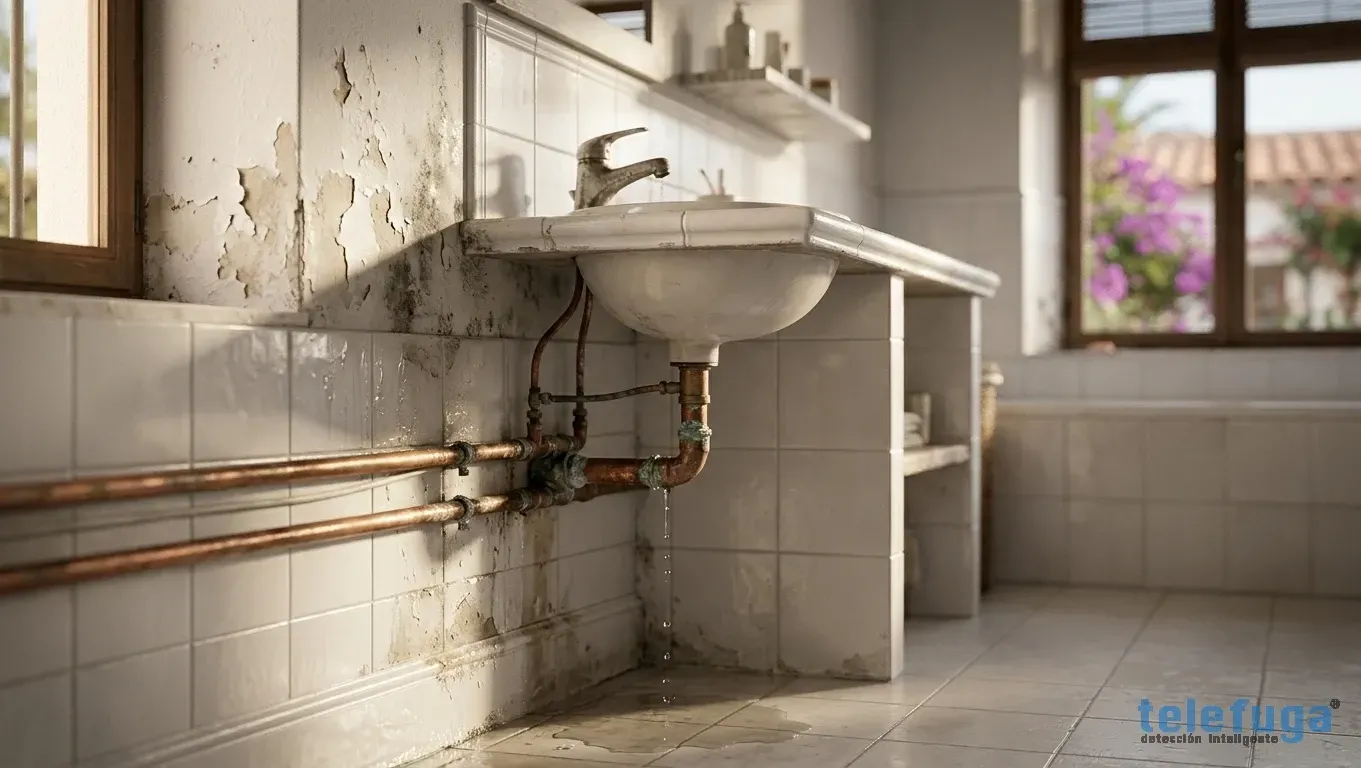
Post-Summer Review of Water Installations: Prevention and Effective Solutions
Make sure your water installations are in optimal condition after summer. Discover how to detect and repair leaks non-in...

Professional water leak detection service without construction work in Valencia, Alicante, Murcia, Albacete and Almería, using tracer gas and geophone. 24-hour phone support. Free quote.
If you detect any of these indicators, you might have a hidden leak.
Unjustified increase in water consumption with no change in habits.
The water level in your pool drops more than usual, and you need to refill it constantly.
The water meter keeps spinning with all the faucets closed. A clear sign of a hidden leak.
Locating the leak before opening up avoids breaking areas that have no leak.
Starting price: from 150 €, call-out included. No-obligation quote.
The final cost depends on the installation and is detailed in the quote.
Request a Free Quote
What looks like natural evaporation can be a hidden leak that is damaging the structure and the ground and pushing up your water bill. At Telefuga we locate leaks in swimming pools while working with the basin full. Warning signs The automatic filler does not stop Damp areas around the basin Cracks in the tiling, lights or skimmers Subsidence in the surrounding ground Air in the pump impellers of the filtration system Most frequent causes Structural cracks in the basin Torn or deteriorated liner Damage to skimmers, lights and fittings Damaged pressure-side and suction-side pipework Aged joints and seals How we do it We work with the pool full: draining it to look for a leak is usually the wrong step, because water is lost without knowing where the problem is, and the basin is exposed to sudden changes in pressure and humidity. First we check separately the water-tightness of the skimmer, pressure-side, pool-sweep and main-drain pipework under controlled pressure, to find out whether the loss is in a circuit or in the basin. That test indicates which section is losing, but not the point; if all the circuits hold, the problem is in the basin. In the basin, a diver checks from inside the cracks, tile and grout joints, return fittings, lights, main drain and wall penetrations, using dye and a camera. In the buried section of a circuit that can be emptied we use tracer gas; the geophone only works on pressurised circuit pipework and is not reliable inside the basin. Before calling: the bucket test Mark the water level in a bucket resting on the step and the level of the pool at the same moment, switch off the automatic filler and wait 24 hours without bathing or topping up. If the bucket and the pool drop by practically the same amount, it is evaporation; if the pool drops several millimetres more, there is a loss that is not evaporation, and the test should be repeated for two or three days. Repeating it with the filter pump stopped gives a clue: if it loses more with the pump running, it usually points to the pressure side; if it loses more when stopped, to the suction side; if it loses the same either way, to the basin itself.

Repair services Structural — cracks and fissures in the basin: sealed with epoxy resins. Underwater — lights, skimmers and return fittings: repair and sealing of built-in elements; depending on the case and the product, without draining the pool. Hydraulic — pipes and circuits: repair of pressure-side, suction-side, overflow and plant-room pipework. What can be repaired from inside and what cannot Many repairs are carried out from inside without opening pipes or excavating: resin lining, polymer injection and sealing allow circuits, fittings and lights to be repaired directly. Three operations should be distinguished: emptying the basin (resin lining a circuit pipe does not usually require this), isolating and emptying only the affected section of pipe, and drying that section, which is a requirement for resin lining. Sealing fittings, lights or wall penetrations from the basin is a different operation and, depending on the case and the product, can be done without draining the pool. Resins are chosen for their compatibility with chlorine and pressure; durability depends on the product and the application. An opening (inspection opening) or replacement of the part is needed when the flexible hose is flattened, there are several consecutive bends, the break is visible, or the main drain or valve is broken: this cannot be sealed from inside. By circuit Skimmer: the connection between skimmer and pipe is sealed by polymer injection; if the housing is cracked, resin lining does not repair it and the skimmer is replaced. Pressure side (return): straight sections with a crack are resin lined; fittings are sealed with elastomers; a split pipe is replaced. Pool sweep or pool cleaner: clamp or hose if the connection leaks; resin lining if there is a crack in a buried pipe; replacement if it is broken. Main drain: if the valve leaks it is replaced; if the pipe leaks, the pressure is tested and a choice is made between resin lining and replacement.

Hidden water leaks cause silent structural damage, push up the water bill and encourage the appearance of mould and damp. At Telefuga we specialise in professional water leak detection with no building work needed at the location stage. How we do it First we confirm that there is a leak and which network it is in: with all taps and appliances shut off, the meter should not move; if it does move, we close intermediate valves (cold water, hot water, heating, irrigation, pool) to see which one stops it. Then we divide the installation into sections using pressure tests and probes to identify the branch that is leaking. Where that branch can be emptied and recharged, we fill it with tracer gas and trace its route with the detector; if the pipe is pressurised and transmits sound, we listen with a geophone. We usually use two techniques: one to locate and another to confirm before marking the point. The aim is for any opening that is needed to be a single one, in the right place; the subsequent repair normally requires a targeted access opening at that point. Where it applies Concealed pipework: hot and cold water inside walls and floors of homes. Service pipes and buried pipework: the route is followed with a probe and listened to with a geophone; if the material is plastic, the section is emptied and tracer gas is used. Communities: risers and general pipework, with sectioning by runs and coordination with neighbours. Swimming pools: skimmer, pressure-side and pool-cleaner circuits with controlled pressure; the basin is checked underwater. Drains and downpipes (soil stacks): without pressure a geophone is of no use; a water-tightness test is carried out and the pipe is inspected with a camera.

A pipe broken inside the wall or under the floor? Demolition is not always required. At Telefuga we repair damaged pipes from the inside using trenchless rehabilitation techniques when inspection confirms they are viable. Techniques we use Interior epoxy resin: an internal coating that seals cracks and creates a new watertight surface. CIPP lining: a textile liner impregnated with resin, introduced and cured in situ to form a new pipe. How it is done Before deciding, a camera inspection of the section is required: only by viewing the interior can it be known whether there is a fine crack (resin lining), a single break or a flattened pipe (replacement). The water supply to the affected section is cut off, and its interior is emptied and dried before the resin is applied; how it is dried and how long it takes depend on the product and the installation. The resin is injected or applied, flows through the pipe, adheres to the walls and penetrates cracks and fissures; as it cures, it forms a new impermeable inner wall. At the end the circuit is pressurised and checked to hold pressure without losses; if any point was not properly covered, it is detected at this stage. In pipes that carry drinking water, only products suitable for potable water are used. When it works and when it does not It works well on cracks, localised corrosion, weak joints and pores in supply pipes, and on pool pressure-side or pool-cleaner pipes. It is not suitable if the pipe is collapsed or flattened, if there are several consecutive bends or changes of material that prevent the resin from flowing, if there are multiple breaks in the same section, or if there is no access for the camera. Lining reduces the internal diameter somewhat and does not correct errors of fall or routing.

The electronic geophone is a listening instrument that amplifies the sound of water escaping through a crack. At Telefuga we use it to locate leaks in buried and concealed pipes without digging to search for them. What it hears and what it needs When water escapes under pressure through a crack it produces a noise that reaches the surface through soil, concrete or wall; the professional geophone filters by frequency to separate it from traffic, a pump or a fridge. It needs pressure in the pipe: more pressure, more noise. Without pressure (drains, downpipes, pool circuits with the pump stopped) there is no jet to hear. The material matters: metal carries the sound a long way; plastic (PVC, polyethylene, multilayer) dampens it, so the leak sounds deeper and duller, you have to listen closer and at more points, and confirming with tracer gas is common. During listening we shut off the water outlets so that the only water noise is the leak: a cistern filling or a running pump can be mistaken for it. When it is used Leaks in service pipes: supply pipes from the mains network to the building. Concealed pipework: plumbing networks hidden inside walls and floor slabs. Buried irrigation networks: irrigation systems in gardens and communal areas. What level of pinpointing to expect There is no universal figure: it depends on the material and depth of the pipe, the pressure, the ground or paving and the ambient noise. With a pressurised metal pipe, hard paving and quiet conditions, the geophone narrows the point down enough to open a single inspection opening; in plastic, soft ground or noisy conditions it narrows down a section that is then confirmed with another technique. The geophone does not confirm the pipe material or depth: that is established with a pipe locator or from the plans.

How it works Tracer gas is a mixture of tracing gases introduced into the emptied pipe with a pressurisation unit and regulator; the gas escapes through the break and a handheld detector picks it up at the surface, where the concentration is highest directly above the leak. Its composition, operating pressure and safety measures are set by the technician according to the product and the applicable regulations. First the section is isolated and drained by opening the low points; if water remains trapped it is expelled with compressed air, because the gas has to fill the entire pipe. Then it is slowly pressurised, with the pressure controlled on a gauge and adjusted to the type of pipe. The technician traces the route with the handheld detector; where there is a leak, the detector gives an audible and visual signal, and the position is refined by seeking the peak concentration. Main applications Swimming pools: buried pressure-side and suction-side pipework. Heating: underfloor heating circuits and radiators. Buildings: buried general networks and service pipes. Fire protection networks: buried sections that can be isolated and emptied. When we choose it and its limits We choose it when the leak does not sound to the geophone: plastic pipes, underfloor heating, buried sections or sections without pressure. It requires being able to empty the section, a point to inject through (a tap or a bleed valve will do) and a surface through which the gas can escape. The gas can travel along joints or voids and emerge somewhat displaced from the real point; very impermeable surfaces or wind outdoors make the reading harder, which is why it is confirmed with a second technique before marking. On very long service pipes without an intermediate outlet, the gas can lose pressure and dilute before filling the whole run; pressurising an old or fragile installation requires great care, and in some cases another method is preferable. It does not locate leaks in the shell of a pool basin: only in the circuit pipework that has been emptied.

Fire protection (PCI) networks are critical systems that must be kept in good condition. A leak in these circuits is not only a waste of water: it reduces the available pressure and can compromise firefighting capacity and the protection of the building. Installations we work on Fire hose reels (BIE) and sprinklers: equipped fire hose reels and automatic sprinklers. Dry risers: water supply systems for firefighters. Booster pump sets: pumping units and storage tanks. How we work on a PCI network We start from the network plans and the booster set, and we sectorise the network using the installation's valves to identify, through a pressure test, the section that is losing; that test tells us which section fails, not the point. On pressurised metal sections we listen with a geophone at contact points and over the ground; on buried sections that can be isolated and emptied we use tracer gas and follow the route with the detector. On large-diameter or very deep pipes both techniques are combined, and location may take longer. Some tests require temporarily isolating sections; this is always coordinated with the maintenance company and the owner, so that the network is not taken out of service without notice. The subsequent repair may require an opening at the located point, and it is verified with a pressure test of the repaired section. What the regulations say The Spanish Fire Protection Installations Regulation (RIPCI, Royal Decree 513/2017) sets out the maintenance reviews of equipment and installations according to its Annex II (art. 21) and, where no specific regulation applies, an inspection every ten years by an accredited inspection body (art. 22). The characteristics of water supply systems must conform to standard UNE 23500 (Annex I of the RIPCI). Locating the section with the leak is the step before any repair of the network.

A leak in the heating circuit is one of the hardest problems to detect: the pipes are hidden inside walls, false ceilings or under the floor. At Telefuga we use infrared thermography and tracer gas to locate the leak point without destructive works. Is your boiler constantly losing pressure? If you need to top up your boiler's pressure every few days, there is probably a leak in the heating circuit. Do not wait for the water to damage the structure or for the boiler to fail from running on low water. Signs of a leak in the heating system Pressure drop in the boiler: you need to top up water frequently. Damp stains on walls or floors: near radiators or concealed pipework. Radiators that do not heat: one or more radiators stop working. High gas bill: the boiler works harder than normal to compensate. How it is located With the system cold we pressurise the circuit to verify the pressure drop; in installations with several circuits, each one is tested separately. Thermography with the system hot shows the route of the pipes as warm lines; a leak interrupts that line or creates a diffuse patch. Thermography sees temperatures, not the leak itself: it needs real thermal contrast, loses effectiveness in deep pipes and produces false positives (thermal bridges, beams, uninsulated areas), so it is used to orientate, not to mark the point. The point is located with tracer gas: underfloor heating pipe is plastic and often does not sound, so the circuit is emptied, charged with a mixture of tracing gases and its escape is traced at the surface. The geophone helps to narrow down the location on metal radiator pipework when the circuit is under pressure. Once located, the floor or wall is opened only in the located area, the section is repaired or replaced, and water-tightness is verified before closing up. Typical leaks in underfloor heating Underfloor heating uses cross-linked polyethylene (PEX) or polybutylene pipes beneath a layer of mortar. Typical leaks are accidental punctures (a wall plug or a screw over the route), a joint defect in the manifold that leaks slowly over years, and deterioration of components caused by untreated water. A patch of floor that is clearly warmer than the rest, outside the normal pattern, can indicate hot water accumulating outside the pipe. Systems we work on Hot water radiators Closed boiler circuits Concealed wall pipework Fan coil systems Boilers and manifolds Radiator valves and lockshield valves

Do you need a technical report to make an insurance claim or to resolve a dispute between neighbours? At Telefuga we prepare technical water leak reports to process a claim with the insurer (its acceptance depends on each policy). What the report contains Location of the leak, with coordinates and a plan. Technology used (geophone, tracer gas, thermography) and what was observed in each test. Technical cause of the failure, according to what was verified during the visit. Complete photographic documentation. Signature of a qualified technician. The report records what can be verified during the visit; if access to an area is not possible, this is stated and an additional visit may be required. When it is needed Leaks between neighbours: when the leak affects several homes and it is necessary to document technically where it originates. Insurance claims: when you want to give the insurer an independent technical report on the origin of the leak. What it is for and what it is not for The insurance company sends a loss adjuster to assess the damage; with an independent technical report you can compare that assessment and present your own documentation. Our report describes the origin and location of the leak. It does not replace the decision of the insurance company or of the loss adjuster it appoints: cover for the claim depends on each policy. It is advisable to notify the insurer of the claim as soon as possible; the legal maximum period is 7 days from when it becomes known (art. 16 of the Ley de Contrato de Seguro, Spanish Insurance Contract Act). Before requesting the report Close the main stopcock to stop or reduce the leak and, if the water is affecting a neighbour, let them know: the Spanish Insurance Contract Act (Ley de Contrato de Seguro, art. 17) requires you to take reasonable measures to limit the consequences of the incident. Before cleaning or moving anything, take photos and videos of all visible damage: damp patches, drips, swollen floors, peeling paint or affected furniture. Article 18 of the Insurance Contract Act sets 40 days, from receipt of the claim notification, for payment of the minimum compensation; actual timescales depend on each case.

Owners' associations face unique challenges when a water leak arises: establishing responsibility, managing insurance, coordinating between neighbours and minimising costs. How we work in a community Leaks between homes or in common areas usually require entering several homes or shutting off the water in some sections to isolate the source; for that reason the property manager or the chair coordinates access before the visit. We section the installation by closing valves, with pressure tests and probes, to identify which riser or branch is leaking before searching for the point. On metal risers and service pipes under pressure we listen with a geophone; on plastic or buried sections we empty the section and use tracer gas; on downpipes and drains, which have no pressure, we carry out a water-tightness test and a camera inspection. If the origin is in downpipes or in concealed general pipework, the repair may require building works or a subsequent CIPP lining, which is quoted separately. The report for the meeting and the insurer When the service requires it, we deliver a detailed technical report with the location, the technique used, photographs and the observed technical cause. That report provides the technical data on the origin; the decision on cover rests with each insurer according to its policy. When the problem affects several flats If several homes show damp patches that may come from a downpipe or a riser, the practical step is for the owners' association management to request the inspection. Many downpipes, or parts of them, are common elements of the building. Whether a specific section is common or private, how the repair is approved and who bears each cost depend on the Spanish Horizontal Property Act (Ley de Propiedad Horizontal), the association's by-laws and the circumstances of the case. The technical report provides information to whoever has to decide, but it does not determine whether the section is common or private or who bears the cost.

Downpipes and soil stacks are the arteries of any building. When they fail, leaks appear between floors, damp in the service shaft, bad smells or seepage on the façade. At Telefuga we rehabilitate downpipes from the inside by lining with a resin liner when the section retains its shape, without replacing the original pipe. How downpipe lining works We insert a textile liner impregnated with epoxy resin inside the existing downpipe. As it cures, it forms a new, watertight pipe within the original one, sealing cracks, open joints and fissures. How it is done Before deciding, the downpipe is inspected from inside with a camera introduced through an access point, inspection chamber or trap, covering the entire section. If the downpipe is cracked but not collapsed, it is fully cleaned, the liner is introduced, a calibration bladder presses it against the walls and it is left to cure for the time the system specifies (often several hours); when the bladder is removed, a new watertight inner pipe remains. If the damage is localised (a crack in a joint, a single break), a short interior liner pressed against the damaged area by an inflatable packer is sometimes sufficient. The downpipe cannot be used during the work and the curing, so neighbours are informed of the timing. Ideal for buildings and communities This technique is especially effective in older buildings, where replacing the entire downpipe would mean working in multiple homes. When it cannot be rehabilitated from inside Collapsed or flattened downpipe: if it has lost its circular shape severely, neither a liner nor resin lining creates a functional duct, and the section must be replaced. Horizontal run without fall: the branches that reach the downpipe need a minimum fall; if it is zero or reversed, interior rehabilitation does not correct it. Poorly resolved connection to the main sewer: rehabilitating the downpipe does not solve a problem at its connection to the sewer. Multiple large cracks along the whole section: interior rehabilitation can be costly and its durability uncertain; replacement may be more practical.
Don't wait for the problem to get worse. Each day of delay can increase the damage and water consumption.
Professional detection equipment: tracer gas, geophone, thermography and inspection camera. Each tool has a specific purpose depending on the type of leak.
We inject a tracer gas into the pipe. The gas escapes through the leak and a sensor detects where it comes out at the surface.
Buried and embedded pipesIt amplifies the sound of water escaping and lets you hear it through walls, floors and concrete without having to break anything open.
Leaks in pressure pipesDetects temperature variations caused by water. Ideal for leaks in underfloor heating, heating, and hidden domestic hot water circuits.
Underfloor heating and heatingRobotized camera that traverses the interior of drains and downspouts, recording video to detect breaks, invasive roots, and blockages.
Drains and sanitation""
Illustrative case based on typical interventions; client data anonymised.
Water bill tripled, 2 walls chiselled open without result. With tracer gas, we located the leak with a 30×30 cm opening.
4 cm/day drop in water level. With a diver + tracer dye, we detected 2 leak points without emptying the pool.
12,000 L/day lost and a special levy already approved. With sectorisation + tracer gas, we avoided the works. Only 1 test pit of 40 cm.
Starting price: from 150 €, call-out included. No-obligation quote. The final cost depends on the installation and is detailed in the quote. Request a free quote..
Usually not. We use non-invasive methods such as tracer gas, geophone, thermography and inspection camera. We narrow down the leak point with different location equipment depending on the type of installation, and we only open up where the leak is. See our methods.
The duration depends on the installation; in many cases the leak is located in a single visit.
24-hour phone service. We will give you the visit date when the service is confirmed. Call us on 693 888 444.
We work in the provinces of Valencia, Alicante, Murcia, Albacete and Almería. For other areas, ask us. Check our coverage..
Yes, the quote is free and without obligation. You can call us, write to us on WhatsApp or fill in our contact form. Contact now.
At Telefuga we are specialists in locating and repairing water leaks. Our team of specialised technicians uses non-invasive methods such as tracer gas, the geophone, thermography and the pipe inspection camera. We narrow down the leak point with different location equipment depending on the type of installation, without unnecessarily breaking walls or floors.
We work on leak detection in homes, residential communities, and commercial and industrial premises. We also handle pool leaks, with qualified divers for underwater inspections when the job requires it, repair of skimmers and cracks, and pipe rehabilitation without construction work.
With our head office in Murcia, we work in the provinces of Valencia, Alicante, Murcia, Albacete and Almería. We have located more than 39,000 water leaks, with a historical 98 % success rate in leak location. More information about water leak detection in Murcia. 24-hour phone support: we tell you the visit date when you confirm the service. We provide a detailed technical report with photographs and conclusions; its validity with the insurer depends on each policy. Request your free quote by calling 693 888 444 or through our contact form.
We help you locate the source and resolve it as soon as possible.
Tips, guides, and updates on leak detection and repair.
Make sure your water installations are in optimal condition after summer. Discover how to detect and repair leaks non-in...
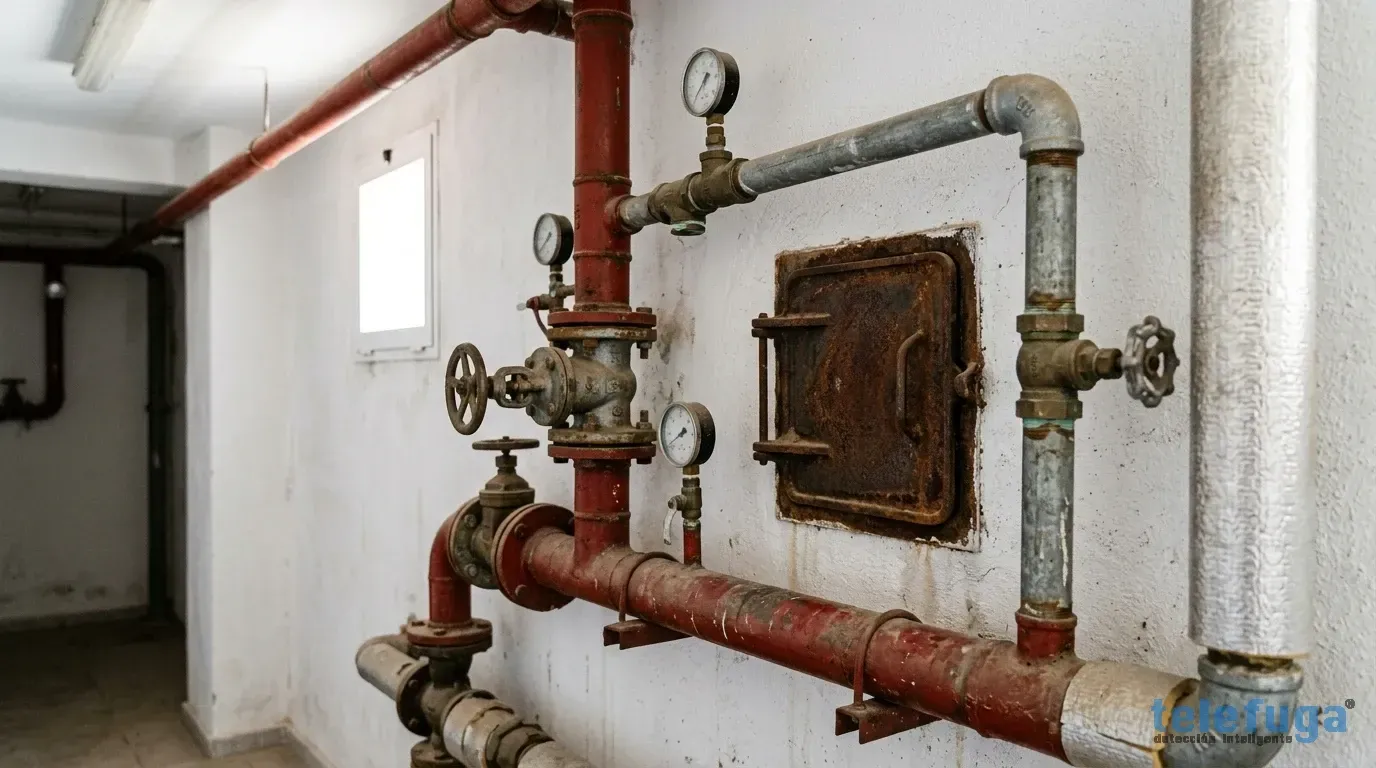
Discover the characteristics, causes and solutions for leaks in fire-protection networks. Keep your infrastructure safe...

Discover why water leaks become more frequent in summer on the Mediterranean coast and how to detect them without constr...
Select your province to see the municipalities with coverage and request a free quote.
No-obligation quote
Call