

Key Points
- Telefuga locates leaks in buried irrigation systems using tracer gas, without excavating the garden or damaging the lawn
- Leaks in automatic irrigation can waste between 2,000 and 10,000 liters daily without the owner noticing
- Tree roots, frost (especially in Albacete), and aging PVC are the most common causes
- Pressure testing by sectors allows isolating the exact area of the leak before intervention
- An annual preventive maintenance (winterization + joint inspection) reduces irrigation leaks by 80%
Data updated in September 2026 — Information verified with internal data from Telefuga and real reviews from Google Maps.
Leaks in Automatic Irrigation: How Much They Cost and How They Are Detected Without Excavation
A leak in a buried automatic irrigation system can waste between 2,000 and 10,000 liters of water per day without the owner perceiving anything abnormal at first glance. At Telefuga, with over 38,000 leaks resolved, a rating of 4.8/5 on Google Maps (319 reviews), and 16 years of experience, we have developed specific protocols to locate and repair leaks in irrigation installations without the need to excavate trenches or destroy gardens.
Automatic irrigation is a complex hydraulic installation that remains buried and hidden underground. Unlike domestic pipes, irrigation conduits are subjected to extreme conditions: direct contact with the ground, invasive roots, daily pressure-decompression cycles, and, in provinces like Albacete, severe frosts that can break PVC. Detecting where the leak is without excavation is the great challenge — and exactly what we do at Telefuga with tracer gas and professional equipment.
Types of Automatic Irrigation Systems and Their Weak Points
Before discussing leaks, it is essential to understand what components make up an automatic irrigation system, as each has its own vulnerabilities.
Pop-up Sprinklers
Pop-up sprinklers are the most common in lawns. They rise when the sector is activated and lower when deactivated. Their weak points are the O-rings of the sprinkler body (which degrade with sunlight and residual chlorine in the water), the threaded connection to the polyethylene (PE) or PVC pipe, and the retraction mechanism (if it gets stuck with sand, it remains partially elevated and loses water constantly).
Diffusers
Diffusers work the same way as pop-up sprinklers but with a shorter range (3-5 meters compared to 8-15 meters). They are used in narrow areas, flower beds, and medians. Their main weak point is the nozzle: if it partially clogs, it generates overpressure in the line that can burst the weakest joint in the sector.
Drip Irrigation
Drip irrigation is the most efficient system but also the most vulnerable to roots. Self-compensating drippers have an internal labyrinth that regulates flow, but fine roots can penetrate through the outlet hole (especially in the clayey soils typical of Murcia and Alicante). When a root clogs a dripper, pressure redistributes and can burst the pipe in another section.
Solenoid Valves
Solenoid valves are the heart of the system. Each sector has a solenoid valve that opens and closes the water flow according to the programmer. The most common failures are: worn diaphragm (the valve does not close completely and drips constantly), burned solenoid (the sector does not activate), and threaded connections that lose tightness over time. Solenoid valves are usually housed in buried boxes that accumulate water and mud, accelerating corrosion.
Access Boxes
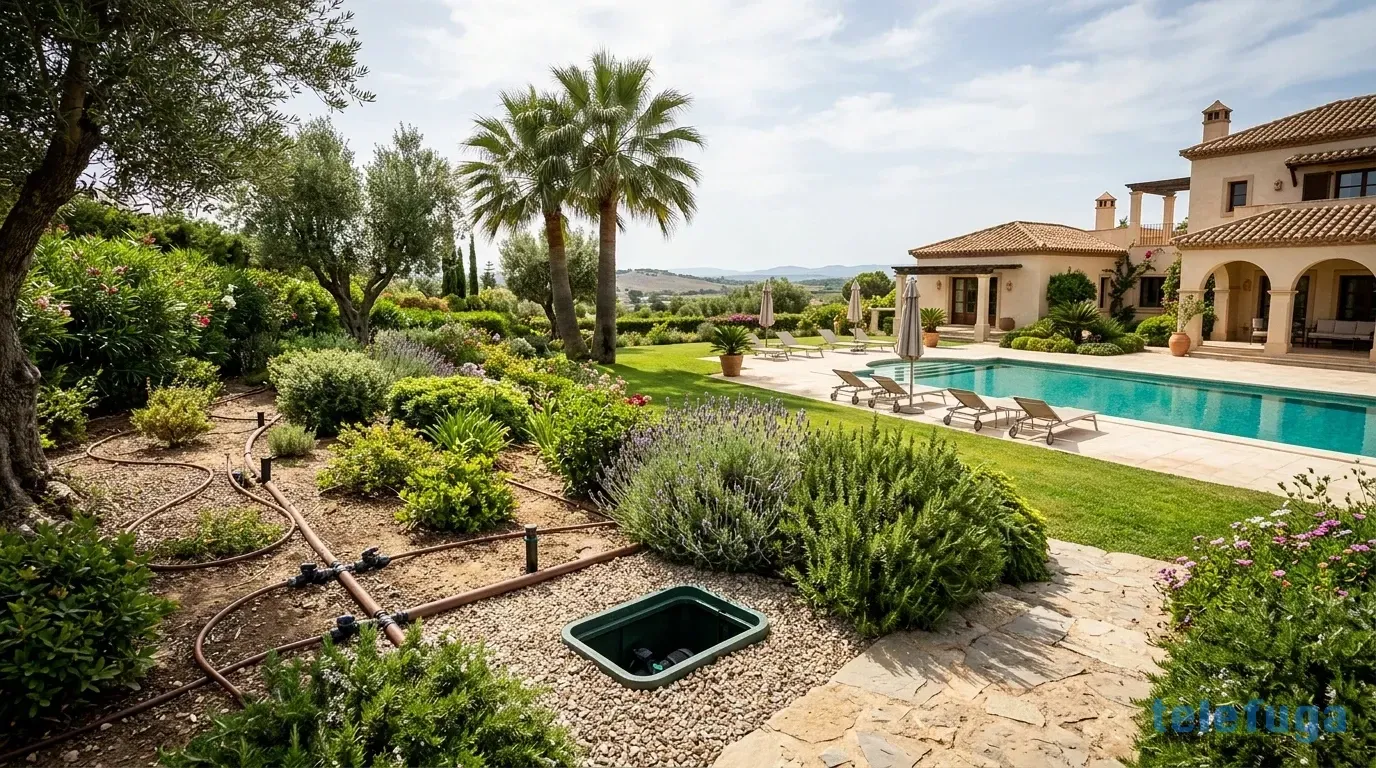
Access boxes are buried boxes (usually green plastic) that house the solenoid valves and main connections. They are a critical point for leaks because they concentrate multiple threaded connections in a small space. Additionally, if the access box does not have adequate drainage, it floods and the metal connections corrode.
Buried Pipes (PE and PVC)
The network of pipes constitutes 80% of the installation and is where most leaks occur. Low-density polyethylene (PE) is flexible and resistant to roots, but its connections with compression fittings are a weak point. PVC is rigid and better withstands pressure, but it is fragile against ground movements and frost.
| Component | Common Material | Main Weak Point | Average Lifespan |
|---|---|---|---|
| Pop-up Sprinkler | ABS / stainless steel | O-ring and threaded connection | 8-12 years |
| Diffuser | ABS | Nozzle and base joint | 6-10 years |
| Self-compensating Dripper | PE | Outlet hole (roots) | 5-8 years |
| Solenoid Valve | PVC + brass | Diaphragm and solenoid | 10-16 years |
| PE Pipe | Low-density Polyethylene | Connections with fittings | 15-25 years |
| PVC Pipe | Pressure PVC | Rigidity (frost, settlement) | 20-30 years |
| Access Box | PP / PVC | Water accumulation and corrosion | 20+ years |
Signs That Your Irrigation System Has a Leak
Leaks in automatic irrigation are treacherous because the system only operates a few hours a day (usually in the early morning) and the loss seeps into the ground without leaving an immediate visible trace. However, there are clear signs that any owner or gardener can identify:
1. Waterlogged Areas or Permanent Mud
If after several hours without watering, puddles or muddy areas appear that do not dry, there is a subterranean leak. Water emerges to the surface when the ground saturates. This is especially evident in clay soils (common in the Vega Baja of Alicante and the Murcia orchard), where water does not drain and accumulates.
2. Greener or Taller Grass in a Specific Area
A patch of grass that grows faster, taller, and greener than the rest is a classic indicator of a subterranean leak. The grass root receives constant water, growing disproportionately. This effect is very visible in summer when the contrast with dry areas is maximum.
3. Pressure Loss in One or Several Sectors
If the sprinklers in a sector do not reach their usual radius or the diffusers emit a weak jet, there is likely a leak in that sector's line. The pressure loss is proportional to the size of the leak: a small fissure reduces the reach by 10-15%, while a broken pipe can leave the sector practically without pressure.
4. Unusually High Water Bill
A leak in automatic irrigation of 5 liters per minute (quite common) means 300 liters/hour x hours of irrigation. If the system irrigates for 2 hours a day, that’s an additional 600 liters daily — 18,000 liters a month — translating to about 40-60€ extra on the water bill. Larger leaks can double or triple consumption.
5. A Sector That Does Not Irrigate Properly
If an entire sector irrigates irregularly (some sprinklers work and others do not, or the programmer indicates opening but no water comes out), there may be a break in the main pipe of the sector or a defective solenoid valve.
6. Water in the Solenoid Valve Access Box
It is normal to find some moisture in access boxes, but if upon opening it is flooded (water covers the solenoid valves), there is a leak in some connection inside the access box or in the supply pipe.
7. Ground Settlements
Sustained leaks over time carry soil particles (internal erosion), creating underground voids that eventually collapse. If small linear depressions appear in the garden, it is very likely they follow the path of the pipe.
Main Causes of Leaks in Buried Irrigation
In our experience with thousands of interventions in automatic irrigation in Murcia, Alicante, Valencia, Albacete, and Almería, the causes repeat with a clear pattern:
Tree and Shrub Roots
Roots are the number one cause of leaks in drip irrigation and also affect PE and PVC pipes. Species like ficus, bougainvillea, olive, and palm have aggressive root systems that actively seek water sources. A micro-leak in a joint attracts roots that penetrate the pipe and burst it from within. In gardens of Murcia and Alicante, where these species are frequently planted, roots are responsible for 35-40% of irrigation leaks.
Ground Settlement
Fill soils (common in new developments) compact over time, generating differential movements that subject rigid pipes (PVC) to bending stresses for which they are not designed. Glued joints crack and pipes break, especially at direction changes (elbows) and branches (tees).
Frost: The Silent Enemy in Albacete and Inland Areas
In Albacete city, temperatures drop below -5°C an average of 15-20 nights a year. Outlying areas like Pozo Cañada, Chinchilla, or Balazote record even more extreme temperatures. When residual water inside the pipes freezes, it expands by 9% and bursts the PVC or deforms the PE joints. Solenoid valves are especially vulnerable because they retain water in their internal chamber even when closed.
Telefuga Fact: In the province of Albacete, 45% of the irrigation leaks we address between January and March are directly caused by frost damage. Winterization (purging pipes with compressed air before winter) prevents 90% of these damages.
Aging PVC and UV Degradation
PVC loses plasticity over time, becoming brittle. This process accelerates if the pipe is installed at shallow depth (less than 30 cm) and receives UV radiation in areas without grass. In climates with high solar radiation like Murcia, Alicante, and Almería, surface pipes can degrade in 8-10 years instead of the expected 25-30.
Poor Original Installation
A significant percentage of the leaks we detect at Telefuga are due to installation defects: pipes without a sand bed (resting directly on stones), glued PVC joints without priming, threads without Teflon tape or with Teflon wrapped in the wrong direction, and lines without drainage valves for winter purging.
Seasonality: When Leaks Occur by Area
The seasonality of leaks in irrigation varies significantly across our 5 coverage provinces:
| Province | High Irrigation Season | Leak Peak | Main Cause |
|---|---|---|---|
| Murcia | April – October | May-June (start) | Roots, aging |
| Alicante | April – October | May-June | Roots, clay soil |
| Almería | March – November | April-May | High UV radiation, salinity |
| Valencia | April – October | May-June | Ground settlement |
| Albacete | May – September | March-April (post-frost) | Frost + start |
The majority of calls we receive for leaks in irrigation are concentrated in May and June, coinciding with the start of the intensive irrigation season. Many leaks were generated during winter (frosts, roots that grew towards the pipe) but do not manifest until the system is pressurized.
How We Detect Leaks in Automatic Irrigation Without Excavation
At Telefuga, we use a specific detection protocol for buried irrigation installations that combines several professional techniques. The goal is always the same: to locate the leak with centimeter precision to intervene with the minimum possible excavation.
Step 1: Pressure Testing by Sectors
The first step is to isolate which sector or sectors have the leak. We close all solenoid valves and pressurize each sector independently with a precision manometer. A sealed sector maintains stable pressure for at least 15 minutes. A sector with a leak shows a pressure drop whose speed is proportional to the size of the loss:
- Slow drop (0.5-1 bar in 15 min): micro-leak in joint or sprinkler seal
- Moderate drop (1-2 bar in 15 min): fissure in pipe or solenoid valve diaphragm
- Rapid drop (pressure to zero in less than 5 min): complete pipe break
Step 2: Tracer Gas (Helium or Hydrogen)
Once the affected sector is identified, we inject tracer gas (a mixture of 95% nitrogen and 5% hydrogen, or pure helium) into the pipe. The gas escapes through the leak, travels through the ground, and emerges at the surface. With a high-sensitivity detector (which measures concentrations in parts per million), we trace the sector until we locate the exact point of the leak.
Tracer gas is the ideal technique for buried irrigation because:
- It works even with the system empty (does not require circulating water)
- It penetrates any type of soil (clay, sand, gravel, grass)
- It locates leaks at depths of up to 2 meters
- It is completely harmless to plants and the ground
- Location precision: ±20-30 cm
Step 3: Correlation with Geophone (when applicable)
In long sections of pipe with constant pressure (like the main line from the meter to the access boxes), we can use the electronic geophone to detect the sound of the leak. Water escaping through a fissure generates a characteristic sound that the geophone amplifies and the technician interprets. This technique complements tracer gas in mixed installations (copper or steel pipe + PE/PVC).
Step 4: Visual Inspection with Camera (accessible pipes)
In large diameter pipes (≥75 mm) like the main lines of community irrigation, we can introduce a miniaturized CCTV camera to inspect the interior condition of the pipe, locate fissures, incrustations, or root penetrations.
Prices for Detecting Leaks in Automatic Irrigation
The prices for leak detection in irrigation vary depending on the complexity of the installation, the number of sectors, and the technique used:
| Service | Indicative Price | Includes |
|---|---|---|
| Pressure Testing by Sectors | From 150€ | Diagnosis of all sectors + report |
| Detection with Tracer Gas | From 250€ | Exact location of the leak + marking |
| Detection + Spot Repair | From 350€ | Location + repair of 1 leak + tightness test |
| Complete Irrigation Audit | From 500€ | Testing of all sectors + tracer gas + detailed report |
| Complex Repair (multiple points) | Custom quote | Multiple repairs + replacement of sections |
All quotes from Telefuga are free and without obligation. You can request it on our quote page.
Leak Repair in Irrigation Without Excavation (or Minimal Excavation)
Once the leak is precisely located, the repair is carried out with the minimum possible intervention:
Spot Repair
If the leak is in a joint, a sprinkler, or a specific section, we only excavate at that point (a hole of 40x40 cm), repair the connection, and refill. In lawns, we carefully remove the sod, set it aside, repair, and replace it. In 2-3 weeks the grass completely closes the scar.
Section Replacement
When the pipe is generally deteriorated (brittle PVC, multiple fissures), we replace the entire section with new pipe, usually high-density PE which is more resistant and flexible. The trench is opened with minimal width (15-20 cm) using a mini-excavator or by hand.
Repair Without Construction (Relining)
In large diameter main pipes, we can apply repair without construction techniques using continuous sleeves or internal lining, avoiding complete excavation.
Real Case: Urbanization with Community Garden Losing 5,000 Liters/Day
Success Case — Urbanization in San Javier (Murcia)
Situation: A community of owners with 48 homes and 3,500 m² of community gardens detects that the water bill has multiplied by 2.5 in the last 3 months. The gardener reports that two irrigation sectors are losing pressure and there is a permanently waterlogged area next to a row of ficus.
Telefuga Diagnosis: We conducted pressure testing on the 8 sectors of the system. Result: 3 sectors with pressure loss. We injected tracer gas into each affected sector and located 4 leak points:
1. Two breaks in 32 mm PE pipe caused by ficus roots that had penetrated the connections with fittings.
2. A 1" solenoid valve with a broken diaphragm that did not close completely (dripping continuously 24/7).
3. A pop-up sprinkler with a deteriorated O-ring that lost water from the base when in operation.
Repair: The two PE connections were repaired, the diaphragm of the solenoid valve was replaced, and the sprinkler seal was changed. Total intervention time: 6 hours. Excavation was only done at the 4 marked points, without damaging the surrounding lawn.
Result: The water bill dropped by 58% in the following billing period. Estimated savings: 1,200€/year in water. Total cost of the intervention: 680€. Return on investment: 7 months.
Preventive Maintenance of Automatic Irrigation to Avoid Leaks
The best leak is the one that never occurs. A simple preventive maintenance program can reduce irrigation leaks by 80% and extend the useful life of the installation by 10-16 years:
Winterization (essential in Albacete and inland areas)
Before the first frost (usually November in Albacete, December in inland Valencia), the system must be completely purged:
- Close the main irrigation shut-off valve
- Manually open all solenoid valves (manual position on the solenoid)
- Connect an air compressor (8-10 bar) to the highest connection point of the system
- Blow each sector for 2-3 minutes until no water comes out of the sprinklers
- Close the solenoid valves and the compressor
- Insulate or protect the access boxes with insulating material (polystyrene, thermal blanket)
Annual Start-up Review (Spring)
At the start of the irrigation season (April-May), dedicate an hour to:
- Slowly open the main valve (to avoid water hammer)
- Activate each sector separately for 5 minutes and visually observe each sprinkler/diffuser
- Check that all sprinklers emerge and retract correctly
- Verify that there are no abnormal puddles or areas that lost pressure
- Open the access boxes and check that there is no accumulated water
- Clean the filters of the irrigation head (if any)
Every 2-3 Years: Preventive Replacement of Critical Components
- Sprinkler O-rings: replace every 3-4 years
- Solenoid valve diaphragms: replace every 5-7 years
- Drippers: check and purge with citric acid annually, replace every 5-6 years
- Programmer battery: replace annually (a dead battery can leave the system watering indefinitely)
Telefuga vs. Gardening Companies: Who Should Detect the Leak?
A common confusion is calling the gardener to detect leaks in irrigation. The gardener is a landscaping and plant maintenance professional, but does not have leak detection equipment or specific training in underground hydraulics.
| Aspect | Telefuga | Gardening Company |
|---|---|---|
| Tracer Gas | Yes (helium and hydrogen) | No |
| Electronic Geophone | Yes | No |
| Calibrated Pressure Test | Yes | Visual (not calibrated) |
| Excavation-Free Location | Yes (±20-30 cm) | No (excavates to search) |
| Technical Report for Insurance | Yes | No |
| 24h Emergency Service | Yes | No |
| Coverage in 5 Provinces | Yes | Usually local |
The recommendation is clear: the gardener maintains the irrigation, Telefuga detects and repairs the leaks. In many cases, we work coordinated with the client's gardener to optimize the intervention.
Irrigation with Regenerated or Desalinated Water: Special Considerations
In Murcia and Alicante, many urbanizations and communities use regenerated water (from wastewater treatment plants) or desalinated water for garden irrigation. This type of water has chemical characteristics that affect the installation:
- Regenerated Water: Higher content of salts, residual chlorine, and organic matter. Accelerates the degradation of rubber joints and can clog drippers.
- Desalinated Water: Low pH and chemical aggressiveness that corrodes metallic components (brass of solenoid valves, steel fasteners).
If your installation uses this type of water, the inspection frequency should be higher (every 6 months instead of annually) and the metallic components should be made of stainless steel or technical plastic.
Frequently Asked Questions About Leaks in Automatic Irrigation
These are the most common questions that Telefuga clients ask about leaks in irrigation systems:
Can a leak in irrigation damage the foundations of the house?
Yes, although it is rare. A sustained leak for months next to the foundations can cause expansion of clay soil (swelling) or erosion of the supporting ground, generating differential settlements that manifest as cracks in the facade. If you detect a leak near the house, act urgently.
Does home insurance cover leaks in automatic irrigation?
It depends on the policy. Most home insurance covers leak detection and water damage, but exclude the outdoor irrigation system from the coverage of “pipes.” However, if the leak causes damage to the house (basement infiltration, damage to flooring), those damages are covered. The expert report from Telefuga is key to documenting the causal link.
How long does Telefuga take to detect a leak in irrigation?
A typical detection intervention in a residential irrigation system (4-8 sectors) is completed in 2-4 hours. Large community systems may require a full day. The repair, if it is spot, is done on the same day.
Conclusion
Leaks in buried automatic irrigation are a silent problem that can waste thousands of liters daily, spike the water bill, and damage gardens, infrastructures, and even foundations. The key to solving it without destroying the garden lies in detection technology: tracer gas and calibrated pressure tests allow locating the leak with centimeter precision, without blind excavation.
At Telefuga, with 38,000 leaks resolved in 16 years of experience, we specialize in detecting and repairing leaks in all types of irrigation installations — from small residential gardens to large urbanizations with community irrigation systems. Our service covers the 5 provinces (Murcia, Alicante, Valencia, Albacete, and Almería) with 24h availability and free quotes.
Suspect a leak in your automatic irrigation? Request a free quote or call us for a quick intervention. The sooner you act, the less water (and money) you will lose.


