
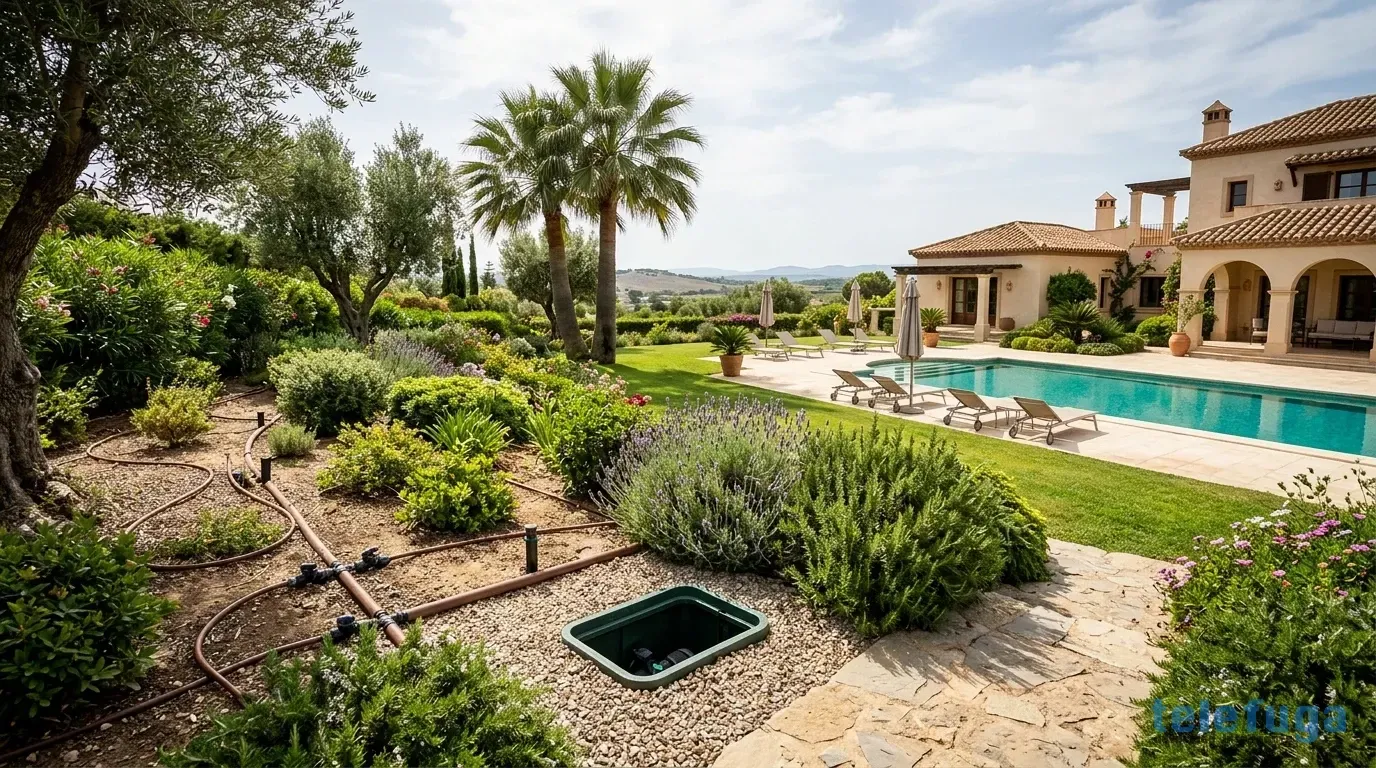
A leak in a buried automatic irrigation system can waste water without anyone noticing. Unlike leaks in homes, irrigation pipes lie underground and are exposed to extreme conditions: contact with soil, invasive roots, daily pressure cycles and, in frost-prone areas, freezing. Detecting these leaks can usually be done without digging up the garden; repair requires minimal excavation, only at the point identified.
Symptoms of a leak in automatic irrigation
Waterlogged area or permanent mud: If puddles or mud that does not dry appear hours after watering, there is an underground leak. Water rises to the surface when the ground becomes saturated, especially in clay soils.
Greener or taller grass in one area: A patch that grows faster and taller than the rest is a classic indicator. The roots receive continuous water and grow disproportionately. Very visible in summer.
Loss of pressure in sectors: If the sprinklers in one zone do not reach their usual radius, there is probably a leak in that zone's line. A small crack reduces reach, and a break can leave the zone without pressure.
High water bill: A leak in irrigation means continuous consumption. The bill can rise significantly if the leak is left unrepaired.
Zone not watering properly: Uneven watering, sprinklers that work while others do not, or a controller that shows the valve open but no water comes out can indicate a break in the main pipe or a faulty solenoid valve.
Sinking ground: Sustained leaks wash soil particles away (internal erosion), creating underground cavities that eventually collapse. Linear sinkholes usually follow the route of the pipe.
Main causes of leaks in buried irrigation
Tree roots: they can damage pipes, especially if trees or shrubs are planted near the network. A micro-leak can attract roots that, in some cases, penetrate the pipe.
Ground settlement: Fill soils compact over time, causing movements that subject rigid (PVC) pipes to bending stress. Joints crack and pipes break, especially at elbows and branches.
Frost: with sub-zero temperatures, frozen water expands and can damage PVC pipes and solenoid valves. Solenoid valves are especially vulnerable because they retain water in their internal chamber. Winterisation (draining the pipes, carried out by a professional before winter) helps prevent this damage.
Ageing materials: PVC loses its flexibility over time and becomes brittle. The process speeds up if the pipe is shallow and exposed to UV radiation.
Poor original installation: Pipes without a sand bed, PVC joints without primer, threads without PTFE tape or with tape wound incorrectly, lines without drain valves.
How leaks in irrigation are detected without digging
Zone-by-zone pressure test
The technician closes the solenoid valves and pressurises each zone independently with a pressure gauge. A sealed zone holds steady pressure. A zone with a leak shows a pressure drop proportional to the size of the loss.
Tracer gas
Tracer gas is introduced into the isolated pipe. The gas escapes through the leak, travels through the soil and emerges at the surface, where a detector helps locate the approximate point of the leak.
Tracer gas requires isolating the zone and, generally, emptying it; its effectiveness depends on the soil and the depth.
Electronic geophone
Amplifies the sound of water escaping. Effective on pipes under constant pressure, such as the main line from the meter. On low-pressure polyethylene pipes, like irrigation lines, the geophone is usually less useful and is combined with tracer gas.
CCTV camera
For main community irrigation pipes, a miniature camera inspects the interior, locating cracks, scale or root penetrations.
Repair with minimal excavation
Spot repair: Excavation is limited to the marked point; the faulty connection or section is repaired and the trench is backfilled. On lawns, the turf is carefully removed, kept, the repair is made, and the turf is put back.
Replacing a section: When the pipe is badly deteriorated, it is replaced with new pipe (usually polyethylene). The trench is opened to minimum width using a mini-excavator.
Preventive maintenance
Winterisation (recommended in frost-prone areas): Before the first frost, a professional blows each zone clear with air at a pressure set according to the solenoid valve manufacturer's specifications. Insulate valve boxes with insulating material.
Annual spring start-up check: Activate each zone separately, check that the sprinklers rise and retract correctly, and confirm there are no unusual puddles.
Replacing parts: replace seals, solenoid valve diaphragms, drippers or the controller battery when you notice wear.
When to act quickly
If you suspect a leak in automatic irrigation and see clear signs (waterlogged area, high bill, zone without pressure), act without delay. Every day of leaking means lost water and money. Professional detection helps narrow down the area to dig without destroying the garden; the repair afterwards is then faster and cheaper.
For a personalised quote or a detection service with tracer gas, request information. See also our guides on leak detection and how to use the water meter to detect them.


