

Key Points
- If your water meter spins without you using any faucet, you have a hidden leak with a probability greater than 95%.
- A small leak can waste more than 300 liters a day (9,000 liters/month) and cost you up to 50 € per month extra on your bill.
- The meter test is a simple method you can do yourself in 2 hours to confirm if there is a leak.
- Telefuga, with over 38,000 leaks detected and a success rate of 98%, uses geophones and tracer gas to locate the exact leak without breaking.
- Acting in time can save you between 200 and 2,000 € in structural damage and wasted water consumption.
Data updated in September 2026 — Information verified with internal data from Telefuga and real reviews from Google Maps.
Why does the water meter spin if I'm not using water?
If your water meter spins when all faucets and appliances are closed, it is almost certain that you have a hidden water leak. At Telefuga, with over 38,000 leaks detected in 16 years of experience, a rating of 4.8 out of 5 on Google Maps with 208 verified reviews, we confirm that the movement of the meter without apparent consumption is the most reliable indicator of a hidden leak.
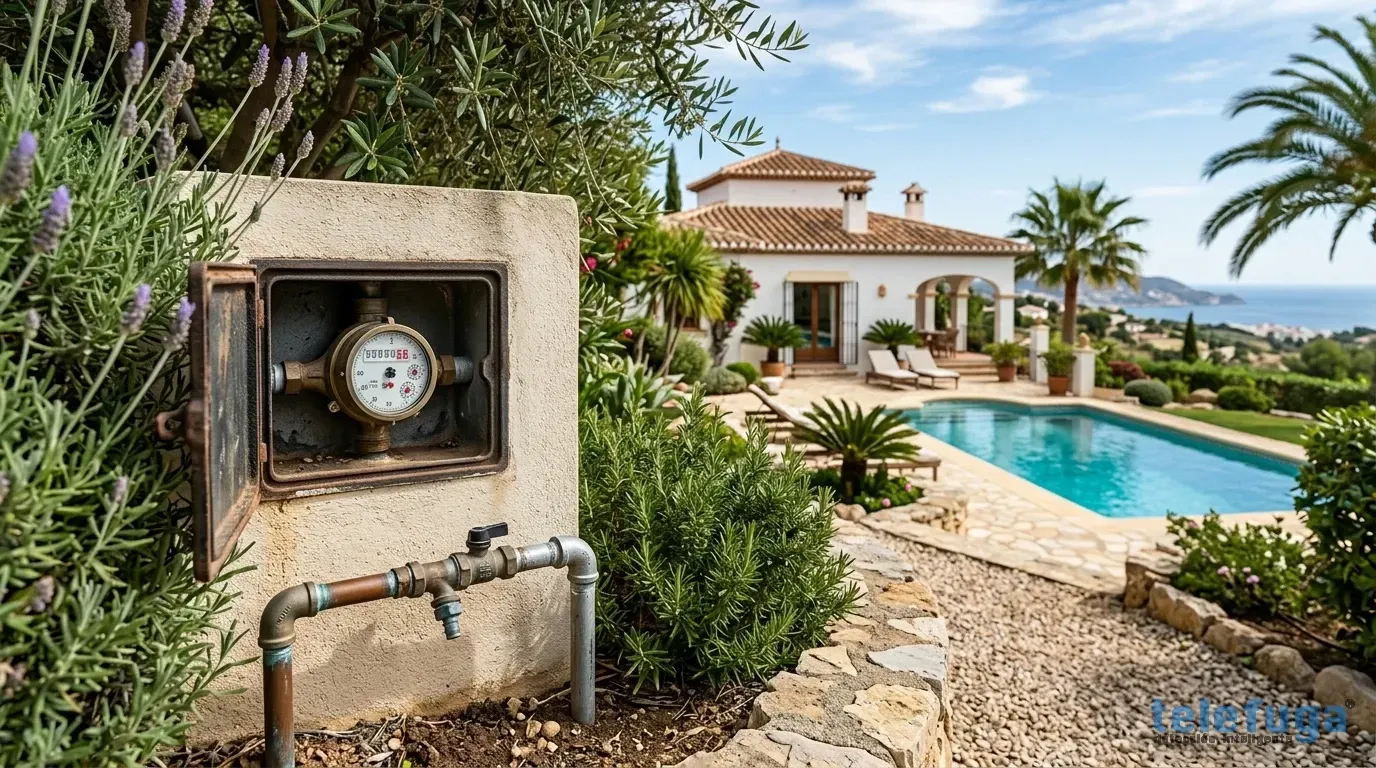
The water meter is essentially a flow meter: it records all the water that passes through it to your installation. If there is no intentional consumption but the meter continues to register water flow, that water is going somewhere — a crack in a pipe, a faulty joint, a deteriorated connection — and you are not seeing where.
Types of water meters and how to read them
Before performing the meter test, you need to know what type of meter you have and how to interpret it correctly.
Analog meter (mechanical)
This is the most common type in Spanish homes. It has a dial with numbers indicating the cubic meters consumed and, very importantly, a small wheel or red triangle (called a “flow indicator” or “star”) that spins when there is water flow, no matter how minimal.
How to read it:
- Black numbers: Complete cubic meters consumed (1 m³ = 1,000 liters).
- Red numbers (or decimals): Fractions of a cubic meter. Example: 0.001 = 1 liter.
- Red wheel/triangle: Instant flow indicator. If it spins even slowly, there is water flow.
Digital meter (electronic)
More modern, with an LCD screen that shows consumption in liters. Some advanced models include instant flow indicators and alerts for abnormal consumption.
How to read it:
- Main screen: Accumulated consumption in m³ or liters.
- Flow indicator: Some show a faucet symbol or an arrow when there is water flow.
- Leak alert: Smart meters can show an automatic alert if they detect continuous consumption for 24 hours.
Smart meter (remote reading)
Water companies are progressively installing smart meters with remote reading. These meters transmit consumption data remotely and can generate automatic alerts to the owner if they detect abnormal consumption patterns. If your water company has sent you a notice of “unusual consumption,” take it seriously.
How to check if you have a leak using the meter: 6 steps
This is the meter test, a simple method you can do yourself without the need for special tools. You only need a pen, paper, and 2 hours of patience.
Step 1: Close all points of consumption
Make sure that no water is being used at any point in your home or property:
- Close all faucets (kitchen, bathrooms, laundry)
- Check that the toilet tank is not refilling
- Make sure the washing machine and dishwasher are off and not in an active cycle
- If you have automatic irrigation, turn it off
- If you have a storage heater, check it (it may have a safety valve that drips)
- If you have a pool with an automatic filling system, turn it off
Step 2: Locate the water meter
The water meter is usually located in:
- Single-family home: In a manhole on the sidewalk or garden, near the entrance
- Apartment in a community: In the meter room of the building (usually on the ground floor or basement)
- Commercial premises: In the installation area or on the facade
Step 3: Note the exact reading of the meter
With all points of consumption closed, note the complete reading of the meter, including the decimals (red numbers). For example: 1.234,567 m³. The more precise you are, the better.
Also observe the red wheel or triangle: is it spinning? If so, you already have a first confirmation of a leak.
Step 4: Do not use water for 2 hours
This is the critical step. For the next 2 hours, do not open any faucet or use any appliance that consumes water. Ideally, do this when all family members are out of the house or during the night.
Tip: if you want a more reliable test, take the reading before going to bed and compare it in the morning (8-hour interval). This will detect even the smallest leaks.
Step 5: Read the meter again
After 2 hours (or 8 hours if you do the night test), return to the meter and note the new reading. Compare both figures.
Step 6: Interpret the result
| Result | Interpretation | Recommended action |
|---|---|---|
| The reading is identical | There is no leak in your installation | Check other possible reasons for the bill increase |
| Difference of 1-5 liters in 2h | Small leak (slow drip) | Check tanks, faucets, heater. If you find nothing visible, call Telefuga |
| Difference of 5-20 liters in 2h | Medium leak (likely hidden pipe) | Contact Telefuga for professional detection |
| Difference of more than 20 liters in 2h | Significant leak (urgent) | Close the shut-off valve and call Telefuga at 693 888 444 (emergencies 24h) |
What does each type of meter movement mean?
Not all movements of the meter indicate the same type of leak. Learn to interpret them:
Continuous and fast spin
If the meter wheel spins continuously and at a noticeable speed (as if a faucet were open), you have a significant leak. It may be a break in a main pipe. Close the shut-off valve immediately and contact a professional.
Slow but constant spin
A slow and continuous spin usually indicates a medium-sized leak, such as a crack in an embedded pipe or a deteriorated joint. It is the most dangerous leak because it can go unnoticed for weeks or months, causing structural damage and dampness.
Intermittent spin (stops and starts)
This pattern usually corresponds to a toilet tank that is leaking water. The tank empties slowly due to a faulty valve, and when the level drops, the float activates the automatic filling. It is the most common cause of “meter spinning by itself” and often has a simple solution.
Very slight movement (barely perceptible)
A minimal movement of the wheel, barely visible, indicates a very slow drip. It could be a faucet that doesn’t close properly, a safety valve on the heater, or a small pore in a pipe. Although it may seem insignificant, a continuous drip of 1 drop per second means 30 liters a day and about 11,000 liters a year.
How many liters are lost and how much does it cost: loss table
To help you gauge the real impact of a leak, we have prepared this table with real data based on our experience:
| Type of leak | Approximate flow | Liters/day | Liters/month | Extra monthly cost* | Extra annual cost* |
|---|---|---|---|---|---|
| Slow drip (1 drop/second) | 0.02 l/min | 30 L | 900 L | 3-5 € | 36-60 € |
| Fast drip | 0.1 l/min | 144 L | 4,320 L | 12-18 € | 144-216 € |
| Thin water stream | 0.5 l/min | 720 L | 21,600 L | 50-80 € | 600-960 € |
| Medium hidden leak | 1 l/min | 1,440 L | 43,200 L | 90-150 € | 1,080-1,800 € |
| Significant leak | 3 l/min | 4,320 L | 129,600 L | 250-400 € | 3,000-4,800 € |
| Pipe break | 5+ l/min | 7,200+ L | 216,000+ L | 400-700 € | 4,800-8,400 € |
*Costs calculated based on the average water rate in the Region of Murcia (2.20-3.50 €/m³ including sewerage and sanitation fee). Prices vary by municipality and consumption tier.
“We detected a hidden leak that had been running for 4 months. The client had paid over 600 € extra on water bills. With our geophone detection, we located the leak in 45 minutes and it was repaired the same day.” — Telefuga Technician
When you can solve it yourself vs. when you need Telefuga
Not all leaks require the intervention of a professional. Let’s see when you can act on your own and when it is necessary to call us:
You can solve it yourself if:
- The toilet tank is leaking: Usually, it is enough to replace the flush valve or the float. Cost of parts: 5-20 €. It is the most frequent cause of “meter spinning by itself.”
- A faucet is dripping: Replace the O-ring or the ceramic cartridge. Cost: 3-15 €.
- The safety valve of the heater is dripping: If it drips only when heating, it is normal (thermal expansion). If it drips continuously, replace the valve. Cost: 10-25 €.
- A flexible connection (hose) is dripping: Tighten the nut or replace the hose. Cost: 5-12 €.
You need Telefuga if:
- You cannot find the source of consumption: You have checked everything visible and the meter keeps spinning. You need a professional leak detection.
- There is dampness on walls or floors without a visible source: The leak is in an embedded or buried pipe. Only with specialized technology can it be located without breaking.
- The leak is under the floor or in the garden: Leaks in buried pipes require detection with geophone or tracer gas.
- You suspect the leak is in the pool: Water losses in pools need specialized diagnosis. At Telefuga, we are leaders with over 8,050 pools repaired.
- The extra consumption is high (more than 50 liters/day): A leak of this magnitude can cause structural damage. Acting quickly is essential.
Telefuga technology to locate hidden leaks
When the meter confirms that there is a leak but you cannot see it, it is time to call Telefuga. We use 4 complementary technologies that give us a success rate of 98%:
1. Electronic geophone
The geophone is a high-sensitivity acoustic amplifier that detects the sound produced by water escaping through a crack in the pipe. Our technicians place sensors at strategic points and “listen” to the installation to determine where the sound of the leak is most intense.
Ideal for: Leaks in embedded or buried metal pipes, polyethylene pipes in the garden.
2. Tracer gas (helium and hydrogen)
An inert gas (helium or a 5% hydrogen mixture) is introduced into the pipe and traced with a high-sensitivity detector to see where the gas emerges through the ground, wall, or pavement.
Ideal for: Leaks in plastic pipes (where the geophone is less effective), underfloor heating, pools.
3. Infrared thermography
A thermal camera captures temperature differences in walls and floors. Filtered water generates a cooler area (or warmer if it is hot water) that is clearly visible in the thermal image.
Ideal for: Leaks in hot water pipes, underfloor heating, identifying the area affected by dampness.
4. CCTV inspection camera
A motorized camera is introduced inside the pipe to visually inspect its condition, detect cracks, obstructions, roots, or displaced joints.
Ideal for: Downpipes, drains, sanitation pipes, pipes accessible from one end.
Other causes of the meter spinning without a leak
Although in the vast majority of cases a meter that spins without consumption indicates a leak, there are some less frequent causes that we should mention:
Variable network pressure
In some supply systems, fluctuations in pressure in the network can cause the meter to register small movements without real consumption. This is more common with old, less sensitive meters that “shake” with water hammer.
Defective check valve
If the check valve (which prevents water from returning to the network) is damaged, water can oscillate back and forth, causing the meter to spin in both directions. In analog meters, this can be misinterpreted as consumption.
Air in the pipes
Bubbles of air in the installation can cause sporadic movements of the meter. This usually occurs after a supply cut or a repair in the main network.
Meter error
Meters have a lifespan of 12 years according to metrology regulations (Order ITC/3022/2007). An out-of-service meter can give erroneous measurements. You can request its verification from the water company.
Steps to claim excess billing due to a leak
If the leak has caused a significant increase in your water bill, you can claim:
From the water company
Many water companies (Aqualia, Aguas de Murcia, EMASA, etc.) have policies for bonus for hidden leaks. If you prove that the excess consumption was due to a hidden leak (not negligence), they can:
- Bill you at the usual consumption tier instead of the upper tier.
- Apply a 50-75% reduction on the excess consumption.
- Split the payment of the excess without interest.
To obtain this bonus, you will usually need to present a repair receipt for the leak. The report from Telefuga serves as a valid receipt for all water companies in the 5 provinces where we operate.
From your home insurance
Some insurance policies include coverage for excess water consumption due to hidden leaks. Check the conditions of your policy or consult our article on what home insurance covers for water leaks.
Additional signs of a hidden leak (besides the meter)
The spinning meter is the clearest signal, but there are other signs that confirm the existence of a leak:
- Damp spots on walls, ceilings, or floors without apparent explanation.
- Mold or damp smell persistent in a room.
- Peeling or blistering paint or wallpaper.
- Floor that lifts or bulges (especially floating floors or parquet).
- Sound of running water inside walls or floors when everything is closed.
- Excessively high water bill without a change in consumption habits.
- Reduced water pressure in any faucet or throughout the house.
- Unexplained puddles in the garden, garage, or terrace.
- New cracks in walls (water can erode foundations and cause settling).
- Abnormally green vegetation in one area of the garden (the leak waters from below).
Practical case: meter that spun by itself in a chalet in Alicante
To illustrate how the complete process works, we share this real case:
Situation
A homeowner of a chalet in San Juan de Alicante detected that his water bill had tripled in the last 3 months (from 45 € to 140 € bimonthly). He performed the meter test and confirmed that the red triangle was spinning slowly and continuously. There were no open faucets, the pool maintained its level, and he did not see dampness in the house.
Intervention by Telefuga
Our technician conducted the inspection in 3 phases:
- Geophone on the house pipes: No significant findings.
- Geophone on the exterior connection (pipe that goes from the meter to the inside of the house, buried in the garden): Clear leak signal 6 meters from the meter.
- Tracer gas to confirm the exact point: Hydrogen emerged at a precise point in the front garden.
Result
- Origin: 3 cm crack in the polyethylene pipe of the connection, caused by the growth of a nearby ficus root.
- Leak flow: Approximately 0.8 liters/minute (1,152 liters/day).
- Water wasted in 3 months: About 103,000 liters.
- Repair: Replacement of the affected section (2 meters of pipe). Total cost: 320 €.
- Detection: 180 €.
- Estimated savings: The leak was costing the owner about 95 €/month extra. Additionally, he obtained the bonus from Aguas de Alicante on the excess billed.
Frequently asked questions about the meter and leaks
Can the meter spin by itself without a leak?
It is possible but uncommon. Alternative causes (air in pipes, damaged check valve, pressure fluctuations) account for less than 5% of cases. In 95% of cases, a meter that spins without consumption indicates a leak.
How much does professional detection cost?
At Telefuga, leak detection starts at 150 €, which includes travel, inspection with geophone, thermography, and technical report. A price that pays off in a few months compared to the cost of an unrepaired leak.
Can I ask the water company to verify my meter?
Yes. You have the right to request the metrological verification of your meter. If the meter is within its useful life (12 years), the verification costs about 30-50 €. If the result shows an error outside the legal limits, the company must replace it at no cost and compensate you.
Prevention: how to avoid future leaks
- Check your meter monthly: Perform the meter test once a month. It is the simplest way to detect leaks early.
- Replace hoses every 5-8 years: Flexible hoses connecting faucets and appliances have a limited lifespan.
- Check toilet tanks annually: They are the number 1 cause of silent consumption.
- Control water pressure: Excessive pressure (above 5 bar) accelerates the deterioration of joints and pipes. Install a pressure reducer if necessary.
- Protect exterior pipes from cold: In areas with frost (Albacete, interior Valencia), insulate exposed pipes to prevent breaks from freezing.
- Hire a professional review every 5 years: A preventive inspection from Telefuga can detect weak points before they become leaks.
Conclusion
If your water meter spins by itself, do not ignore it. Every day of delay means wasted liters of water, a growing bill, and an increasing risk of structural damage. The good news is that confirming the leak is as simple as performing the meter test, and resolving it can be quicker and cheaper than you think.
At Telefuga, we have 16 years and over 38,000 leaks detected helping homeowners in Murcia, Alicante, Valencia, Albacete, and Almería. With our geophone and tracer gas technology, we locate the exact leak without unnecessary work, with a success rate of 98%.
Is your meter spinning by itself and you don’t know where the leak is? Request your free quote or call us at 693 888 444. We are available 24 hours, 365 days a year. Leak detection from 150 €.


