
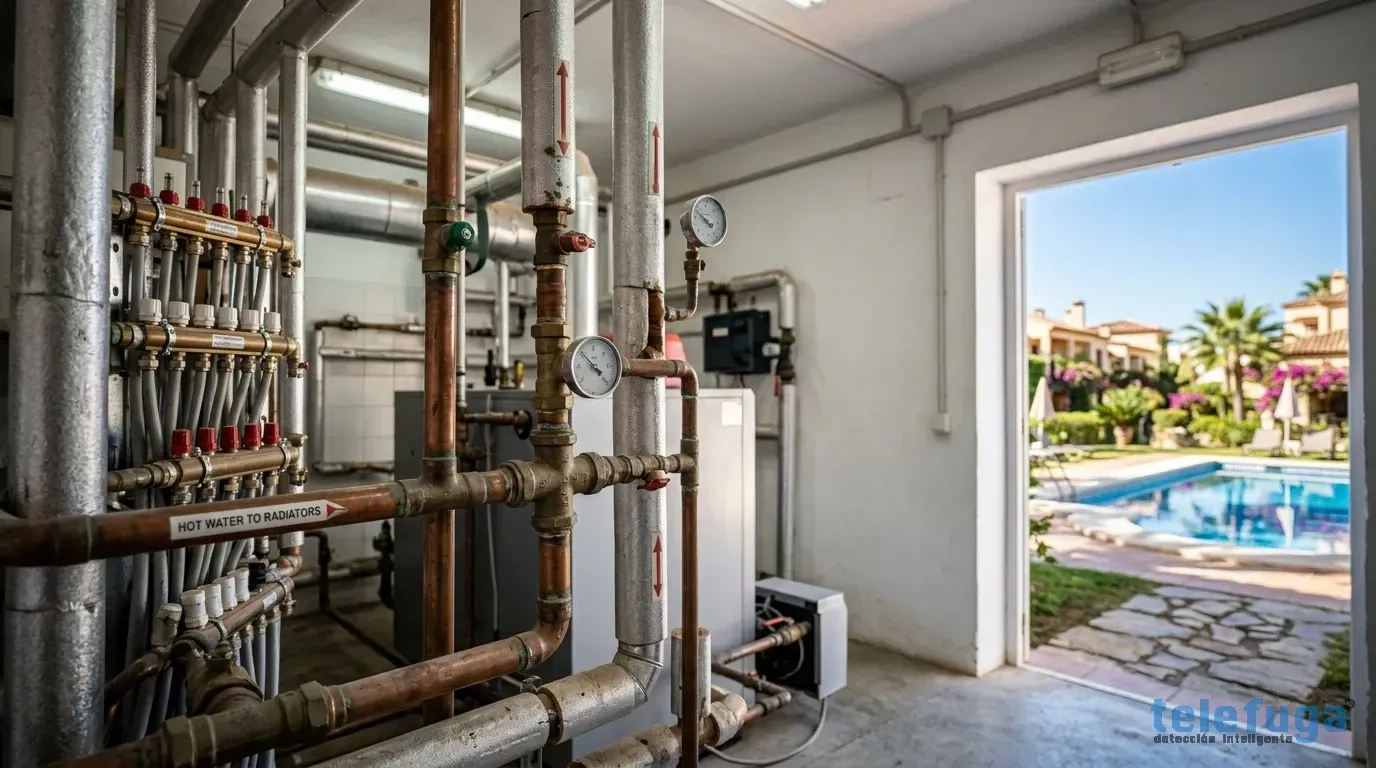
A heating circuit is a closed system where the pressure should drop very little. If you need to top it up frequently, there is probably a leak. Hot water can accelerate the corrosion of metals. Leaks in heating require urgent diagnosis because each top-up introduces oxygen-rich water that can speed up corrosion.
Symptoms that indicate a heating leak
Constant pressure loss in the boiler
This is the main symptom. A cold circuit should hold a steady pressure. If you need to top it up often, there is probably a leak. Some owners top up the circuit as a routine without checking anything: that makes the problem worse.
Uneven heating: cold radiators
A leak in the section that feeds one zone leaves the radiators in that zone with low pressure or no water. It shows because one room does not heat up like the others.
Damp stains on the floor or skirting boards
Especially with underfloor heating, leaked hot water saturates the screed over time. Dark stains, damp at the base of the walls or swelling of laminate flooring appear.
Noises in the pipes
Gurgling, bubbling or hissing. They can come from air entering the circuit each time it is topped up (air dissolved in the water), which can accelerate internal corrosion.
Floor or wall that is unusually hot
If you walk barefoot and find a spot that is significantly hotter than the rest (not following the normal pattern of underfloor heating), it may indicate hot water collecting outside the pipe under the tile.
How a heating leak is located
Pressure test and location
With the system cold, the circuit is pressurised to check for pressure drop. In systems with several circuits, each one is tested separately. Thermography with the system hot shows the pipe layout as hot lines; a leak interrupts that line or creates a diffuse patch. The geophone helps narrow down the point, or tracer gas can be used if the pipe is plastic.
Repair with a minimal opening
Once located, the floor is opened only over the affected area, the damaged section is repaired or replaced, and watertightness is checked before closing it up.
Leaks in underfloor heating
Underfloor heating uses cross-linked polyethylene (PEX) or polybutylene pipes that run in a serpentine under a layer of mortar. The typical leaks are:
- Accidental puncture: Someone drives a wall plug into the wall without knowing the layout of the circuit, or screws directly into the floor, breaking the pipe under the tile.
- Defective joint at the manifold: The ends of the circuits finish at a manifold (distributor). A faulty joint leaks slowly for years.
- Deterioration of components: Untreated or poor-quality water can slowly corrode the metals in the circuit and cause leaks at joints and connections.
- Structural settlement: Minimal movement of the building stresses the pipes where they cross expansion joints, causing micro-cracks.
Leaks in radiator circuits and pipes
In traditional systems with radiators, leaks occur at:
- Radiator inlet and return valves: The gaskets degrade with thermal cycling.
- Air vents: A loose air vent drips constantly. It is the easiest leak to repair.
- Joints between radiator sections: In older radiators, galvanic corrosion weakens the joints.
- Expansion vessel: If the internal diaphragm breaks, the pressure can rise and make the safety valve discharge water.
Why constant topping up makes things worse
Many owners "fix" the pressure loss by topping up the circuit again and again. This speeds up the problem:
- Each top-up introduces dissolved oxygen: A closed circuit that is not topped up loses its oxygen after the first corrosion reactions. Topping up brings in fresh oxygen, which can reactivate corrosion.
- Limescale from the mains is deposited in the boiler: In hard-water areas, each top-up can bring limescale salts that build up in the heat exchanger and can reduce its efficiency.
- The leaked water causes collateral damage: It does not disappear; it can collect under the screed and cause damp in the floors below.
- A leak does not repair itself: The usual outcome is that it gets worse.
When to act
As a rough guide:
- Topping up now and then: monitor and check accessible valves. If it persists, a professional inspection is advisable.
- Topping up frequently: probable leak. Contact a leak detection professional.
- Topping up almost daily: serious leak. Act as soon as possible.
- New damp stains + pressure loss: the leak is becoming visible. Urgent intervention needed.
Preventive maintenance
Annual check (September–October)
Do this only with the boiler switched off and the circuit cold, without touching gas or electrical components. If the pressure is below the manufacturer's value or you are unsure, do not keep topping up: the boiler and its gas or electrical components may only be handled by a professional legally qualified for that type of installation, such as the boiler's technical service or a qualified installer.
- Check the cold pressure: it should be at the value given by the boiler manufacturer (usually between 1 and 1.5 bar). If it drops often, there may be a slow leak.
- Bleed all the radiators: open each air vent until water comes out without bubbles. Start with the ones furthest from the boiler.
- If the pressure is below the manufacturer's value, call the boiler's technical service or a qualified installer instead of topping up repeatedly.
- Inspect visually: valves, radiators, elbows, connections. Look for drips, rust, white efflorescence.
- When you have finished bleeding, switch the heating on for a while. Check that all the radiators heat up and that there are no abnormal noises.
- Check the pressure again: if it has dropped compared with the initial reading, there may be an active leak.
Bleeding and correct pressure
Bleed at the start of each season and in mid-winter. Usual values: when cold, around 1 to 1.5 bar, depending on the boiler manufacturer. If you need to bleed or top up often, it usually indicates a leak.
Summary
Pressure loss in heating is not normal. If you need to top up the circuit often, there is probably an active leak that can get worse over time. Each top-up accelerates internal corrosion.
A professional diagnosis using a pressure test, thermography and a geophone can locate leaks in underfloor heating and traditional radiators and, in many cases, allow the repair to be done through a small opening. The location is carried out by a professional qualified in leak detection; if the repair affects the boiler, gas or electrical components or other parts of the heating installation, it must be done by a professional legally qualified for that type of installation. Do not wait until the leak is visible or causes structural damage.
See also our guide on how to detect leaks with the water meter, the comparison of detection techniques, and if you need professional help with heating leak detection.


