
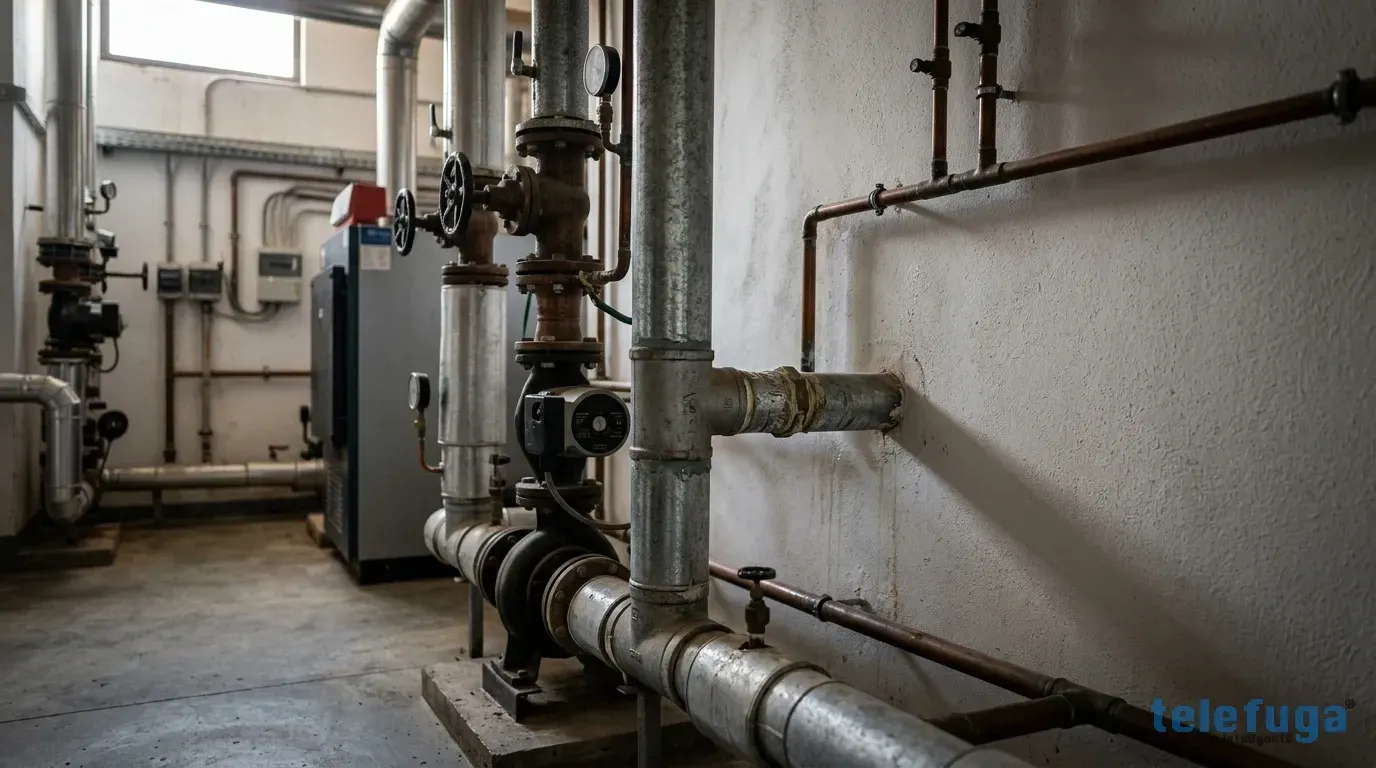
A home's pipes should not make noise. When they do, something in the system has changed: a pressure variation, trapped air, or an active leak. There are six main types of noise, each with a different cause and level of urgency. The key is to distinguish between harmless mechanical noise (water hammer, air) and noise that indicates a real leak (dripping, bubbling).
The 6 types of pipe noise and what they mean
1. Water hammer: the thump when a tap is closed
A sharp, strong knock that runs through the pipes each time a tap, dishwasher or washing machine valve is closed abruptly. It sounds like a metallic "bang".
Cause: When water flow stops suddenly, the kinetic energy of the moving water rebounds off the pipe walls. That pressure wave creates intense vibrations. With high mains pressure, the impact can cause transient pressure spikes.
Does it indicate a leak? Not directly, but repeated knocks fatigue joints and welds. They can cause micro-cracks that, over time, turn into leaks.
Solution: Install a water hammer arrestor (air chamber or mechanical device) next to the problematic valve. If you have had water hammer for years, it is advisable to inspect for accumulated damage.
2. Whistling or high-pitched squeal: excessive pressure or restriction
A continuous whistle usually means water is passing through a narrower space than normal: a partly closed valve, a damaged pressure regulator, or limescale build-up.
Cause: When a fluid passes through a narrow section, it speeds up and its pressure drops. That acceleration creates turbulence and the characteristic whistle. The frequency (high or low pitch) indicates the degree of restriction.
Does it indicate a leak? It can. If the whistle is new (it did not exist before), there may be a partial break creating an outlet.
Self-check: Close the main stopcock. If the whistle stops, the problem is inside your installation. If it continues, it is in the external network.
3. Gurgling: air trapped in the system
A sound similar to a bottle emptying. It is especially common after supply cuts or when opening taps that have not been used for some time.
Cause: Air enters during supply cuts (partly emptied pipes), through deteriorated joints, or through temperature changes that create air pockets.
Does it indicate a leak? Normally not. Exception: if the gurgling is constant after bleeding the system, there may be a small leak letting air in continuously (especially in buried polyethylene pipes).
4. Bubbling: possible active leak
Different from gurgling: it is a regular sound, like something boiling inside the wall. It has a steady rhythm.
Possible cause: An active leak in a concealed pipe where water escapes under pressure and creates bubbles when it mixes with air in the wall cavity. It is a sign that deserves checking.
Does it indicate a leak? It can. It is worth confirming with the water meter test or with a professional.
5. Constant vibration or humming
A vibration that is felt more than heard, coming from poorly secured pipes or from excessive mains pressure.
Cause: Metal pipes expand and contract with changes in water temperature. If the fixing clips are loose, this expansion causes friction and vibration.
Does it indicate a leak? Rarely. But it can mask more subtle noises.
6. Dripping: a clear sign of a leak
A rhythmic "tic, tic, tic" inside a wall, floor or ceiling is the clearest sign of an active leak. If you hear dripping with all taps closed, a leak is very likely.
Does it indicate a leak? It is a clear sign of a leak. It requires a professional inspection.
Self-check: what you can test before calling
The water meter test
- Close all taps in the home.
- Make sure no appliance is using water.
- Note the exact reading on the meter.
- Wait a reasonable amount of time without using water.
- Read the meter again. If it has changed, water is being used with no apparent use: probably a leak, which should be confirmed by a professional.
This is the most reliable check for water loss. If the meter moves with taps closed, there is real water loss, regardless of how it sounds.
Isolating the area of the noise
- Locate the wall or floor where the noise is loudest.
- Close the stopcocks of specific areas (bathroom, kitchen) and check whether the noise disappears.
- If it stops when you close an area, you have isolated where the problem is.
Look for visible evidence
- Damp stains on walls, ceilings or floors.
- Paint that bulges or flakes off.
- Mould or an unusual damp smell.
- Tiles that sound hollow (water trapped under the floor covering).
- Rise in the water bill without a change in habits.
When to call a professional
These patterns indicate you need professional detection:
- Noise persists with all taps closed: Water is circulating without your use. A leak is the most likely cause.
- Noise appears suddenly: A sudden change in the sound pattern may indicate a new break.
- Noise is getting louder: A small leak is getting bigger. The noise grows week by week.
- Night-time noise: At night, mains pressure usually rises (less general consumption). Leaks are more audible when there is less background noise.
- Noise + damp stains: The combination is very indicative. Act urgently.
- Noise + high bill: Real water loss is happening.
How a professional locates it
The geophone is the usual tool on metal pipes under pressure; on plastic it is usually combined with tracer gas. It is a very sensitive contact microphone that amplifies the sound of water escaping under pressure. The technician:
- Walks along the route of the suspect pipe, placing the geophone at evenly spaced points.
- Compares the intensity: the point where the noise is strongest is closest to the leak.
- Marks that point precisely.
- Confirms if necessary with tracer gas or thermography.
On plastic pipes the sound is faint. Then the geophone is combined with tracer gas: the pipe is emptied, tracer gas is introduced, and the detector marks where the gas escapes to the surface.
Summary
Not all pipe noises are an emergency, but they should not be ignored either. The key is to distinguish between harmless mechanical noise (water hammer after closing a tap) and noise that indicates real water loss (dripping, constant bubbling, noise with taps closed).
The most reliable check is the water meter: close the taps and see whether it moves. If it moves, a leak is probably present and should be checked. If it does not move, the noise may be air or a transient sound, although the test should be repeated. Once a leak is confirmed, professional location with geophone and tracer gas allows the leak area to be narrowed down and limits the opening to what is necessary.
See also the comparison of detection techniques and learn how to read the water meter.


