
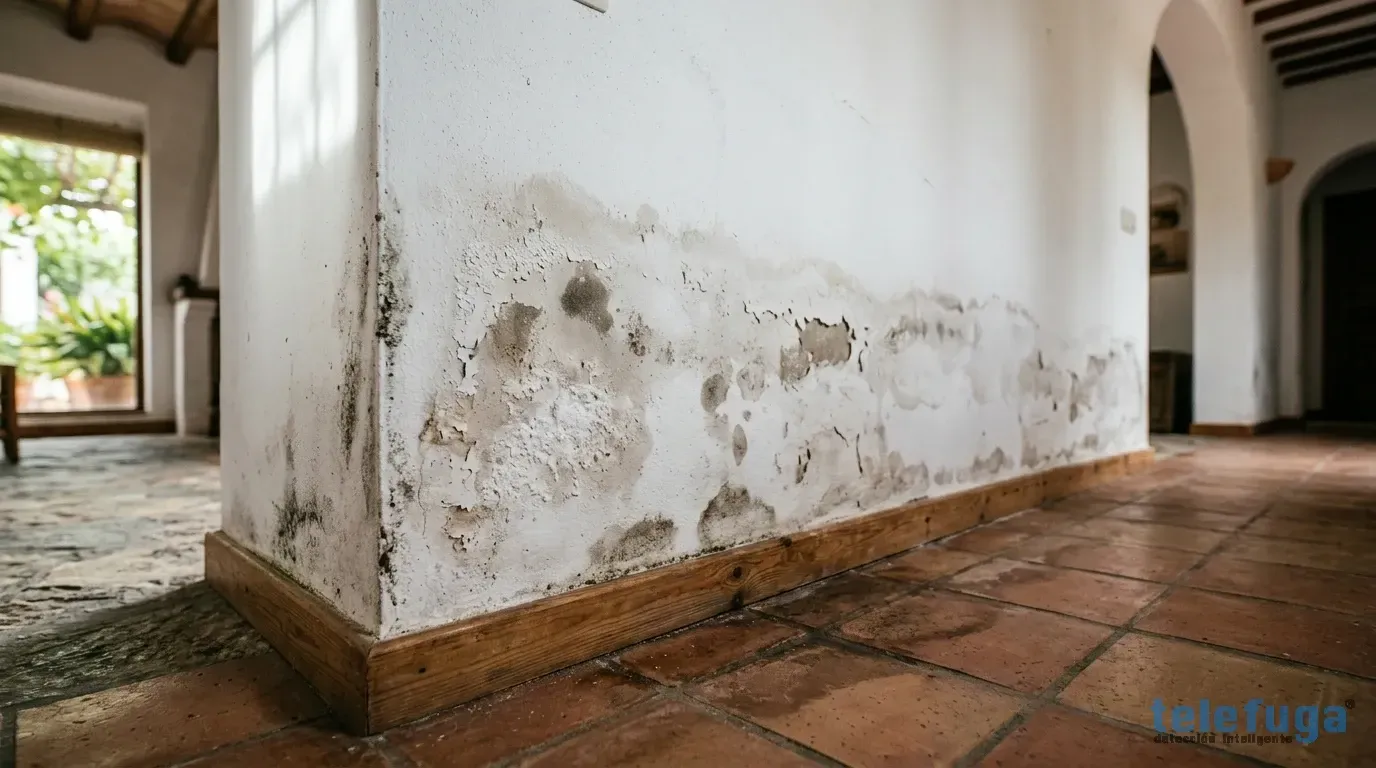
Damp on walls has many causes, and each one needs different treatment. Distinguishing harmless condensation from a hidden pipe leak can prevent unnecessary repairs. This article guides you through the main causes and how to identify them.
The main causes of damp on walls
Condensation
Water vapour in the air condenses when it touches a cold surface. It appears especially in winter in room corners, behind furniture placed against external walls and around window frames. It is identified by black or greyish mould, improvement with ventilation, and a pattern that worsens in wet seasons.
Solution: Ventilate regularly, install extractor fans in bathrooms and kitchens, improve wall insulation.
Rising damp
Ground water rises through the pores of bricks and mortar. It is identified by an irregular horizontal line with white efflorescence (mineral salts) at the bottom of the wall, and by the fact that it persists regardless of rain or season.
Solution: Injection of water-repellent resins, external perimeter drainage. Surface solutions (anti-damp paint) only mask the problem.
Penetrating damp through the façade
Rainwater penetrates through cracks, deteriorated joints or porous coatings. It appears after heavy rain on external walls, around windows, and it usually dries out partially between rainy spells.
Solution: Crack repair, joint sealing, breathable water repellent on the façade.
Leak in a concealed pipe
Cold or hot water pipes inside walls can crack due to corrosion, material fatigue or defective joints. The stain is usually circular or oval, grows progressively, does not depend on rain, and remains constant.
This is the hardest diagnosis without professional equipment, but also the most critical, because the water continuously damages the structure.
Leak in a drain or soil stack
Cracked waste water pipes cause dark stains, possibly with a yellowish or greenish tone, often in a vertical band affecting several floors at once, with a characteristic unpleasant smell.
Solution: Inspection with a CCTV camera and internal inspection; in many cases, repair without demolition (for example, with pipe lining).
Leak from the neighbour
Water seeps by gravity through floor slabs and party walls, sometimes showing up far from the original leak. It is especially frustrating because the solution depends on the neighbour acting.
What to do: notify the neighbour or the managing agent and, if the origin is not clear, request a professional detection (for example, with infrared thermography) to document it. A technical report describes where the water comes from; who must bear the damage is a separate question, which depends on each case and on the policies, and may require the judgement of an assessor or a legal adviser.
Leak in the heating circuit
Underfloor heating or radiator pipes carry hot water under pressure. A leak can be especially problematic because hot water can accelerate corrosion. It is identified because it appears when the heating is switched on and improves when it is switched off, and because the floor is abnormally hot at a specific point. See our guide on leaks in heating systems for the full symptoms and location methods.
Solution: infrared thermography, one of the usual techniques for this type of leak, and a targeted repair.
Leak through the roof or terrace
The waterproofing membrane deteriorates over time. It appears as yellowish or brown stains on the ceiling of the top floor, directly related to rain, and it can take hours or days to show.
Solution: Waterproofing of the roof with a new membrane or sprayed polyurea.
Symptoms table: identify your type of damp
| Observable symptom | Probable cause | Is it a water leak? |
|---|---|---|
| Black mould in upper corners, in winter | Condensation | No |
| White salts at the base of the wall | Rising damp | No |
| Stains after heavy rain, external wall | Penetrating damp through the façade | No |
| Circular stain that grows, not dependent on rain | Leak in a concealed pipe | Yes |
| Dark vertical band with a bad smell | Broken soil stack | Yes |
| Damp on the ceiling unrelated to rain (with another dwelling above) | Leak from the neighbour | Yes |
| Warm floor + damp on the skirting board with the heating on | Heating leak | Yes |
Five signs that point to a real leak
1. The stain does not depend on rain or season — If it stays constant, there may be a continuous source of water (a leak or, on the ground floor, rising damp): check it with sign 2.
2. The meter turns with the taps closed — This is the simplest test. The meter test shows that water is being lost in the installation.
3. The water bill has risen without any change in habits — A significant increase compared with the previous year is suspicious.
4. The stain is on an internal wall far from the exterior — It helps rule out rising damp, façade penetration and condensation.
5. The wall is warm at the damp spot — It suggests a leak in a hot water pipe or in the heating circuit.
Damp on bathroom and kitchen floors: a special case
Damp stains on bathroom and kitchen floors have different causes from those on walls, and it is important to tell them apart to avoid unnecessary repairs.
Leak in the drain, trap or shower tray seal
They appear only when the appliance is in use (shower, basin, bath). The water is visible under the tray or around the connections. It is usually visible when you open the cupboard under the basin. The repair is usually simple: tightening joints, replacing the trap or the rubber seal.
Leak in a pressurised water pipe under the floor
The meter turns with the taps closed (this is the key test). The stain appears unrelated to the use of appliances, and it grows progressively. It requires professional detection to locate the point of the leak.
Seepage from the flat above or from the neighbour
Water travels by gravity from the flat above. It usually affects the lower area (below the ceiling of the flat underneath). Technical diagnosis helps determine the origin; responsibility depends on each case and is not settled by a technical report on its own.
Rising damp on the ground floor
It mainly affects ground floors or basements, with characteristic white salts, and does not usually appear on upper floors.
Practical steps: First, do the meter test with everything closed. If it turns, there is a hidden water leak. If the meter is still, the damp may be due to drains, seepage from above, rising damp or a closed heating circuit: check the heating section.
How it is detected professionally
With professional detection, two main techniques are used:
Infrared thermography: A thermal camera captures infrared radiation. Water alters the surface temperature of the wall, which can help show where there is an anomaly, its approximate extent and the path the water takes.
Electronic geophone: It amplifies the sound of water escaping through a crack. It helps locate the leak even in pipes under the screed or ceramic flooring.
Combined, these techniques can in many cases locate the leak with less demolition.
Risks of ignoring the damp
Persistent damp is not just an aesthetic problem. It encourages mould and fungi that release spores into the air, and can contribute to respiratory problems and allergies. Sustained leaks can affect the structure and, in some cases, cause cracks in façades.
Common mistakes when dealing with damp
Mistake 1: Applying anti-damp paint without a diagnosis. It only hides the stain; the damp keeps causing damage inside.
Mistake 2: Assuming it is condensation just because it is a bathroom. Bathrooms concentrate concealed pipes; sometimes a leak is mistaken for condensation.
Mistake 3: Breaking walls to look for the leak by eye. Destructive and expensive. With a geophone or thermography (if the water is warm), the area can often be narrowed down before demolition.
Mistake 4: Blaming the neighbour without evidence. It creates unnecessary conflict; a technical report can document the origin.
Practical steps now
- Do the meter test. If it turns with the taps closed, there is a hidden water leak.
- Observe the stain: is it growing? Does it depend on rain? Does it smell of mould? Note its characteristics.
- If there are signs of a real leak, request a quote for professional detection with thermography and a report.
- Do not touch the walls or apply paint until you have a clear diagnosis.
A professional detection can avoid repairs based on assumptions. If the leak is not yours, a technical report can serve as documentation.


